Deinfluencing is influencing with a minus sign in front of it. Same creator, same parasocial trust you built over two hundred videos, same engagement economy paying out for confident opinions delivered fast. The only thing that changed is the direction of the arrow, and the arrow still points at a product roughly as often as not, because the honest “do not buy this” video and the “do not buy this, buy my cheaper one” video are shot in the same room by the same person with the same ring light. That does not make the trend worthless. It makes it a symptom of the right problem and a solution to almost none of it.

What does deinfluencing actually mean?
The word appeared properly in early 2023 and it means what it sounds like: a video where a creator tells you not to buy something. The genre grew out of a specific fatigue. For about a decade the dominant format on beauty and lifestyle feeds was the haul, where somebody empties a shopping bag onto a bed for eleven minutes, and by 2023 a critical mass of viewers had bought the viral thing, been disappointed by the viral thing, and wanted somebody to say so out loud.
So the format inverted. The overhyped lip liner, the mascara everybody had, the water bottle that was a personality for a season: someone finally said it was fine at best. That was useful. Naming a shared disappointment is genuinely valuable, and for a few months deinfluencing did something the feed had never done, which was to make not buying watchable.
Then the format matured, which in feed terms means it got monetized.
What is underconsumption core, and is it the same thing?
Underconsumption core is the aesthetic wing of the same backlash, and it arrived about eighteen months later. Where deinfluencing is a verb, underconsumption core is a look: a shampoo bottle scraped to the end, a phone with a cracked case that still works, eleven items of clothing that cover a whole year, a bathroom counter with four things on it instead of forty.
The impulse behind it is good. A whole generation calibrated its sense of “normal amount of stuff” against feeds where everyone appeared to own a small branch of Sephora, and seeing an ordinary cupboard again resets that dial. Empties videos, capsule wardrobes and use-it-up challenges all do the same quiet work: they show you that the baseline you were comparing yourself against was staged.
The failure mode is subtle and it is already visible. An aesthetic can be shopped for. The moment underconsumption becomes a look rather than a habit, there is a version of it that requires matching amber glass jars, the correct linen, a wooden dish brush and a very specific beige. You can spend three hundred pounds on the appearance of not spending money, and the feed will happily sell you the starter kit. This is the same move the algorithm makes with every value you express: it does not talk you out of your position, it finds the merchandise for it.
Is deinfluencing still influencing?
Yes, and it is worth being precise about why, because the mechanism does not care about the content of the recommendation.
| A haul video | A deinfluencing video | |
|---|---|---|
| Who is talking | Someone you trust from a hundred videos | Someone you trust from a hundred videos |
| What powers it | Parasocial confidence | Parasocial confidence |
| How it is paid for | Views, affiliate links, brand deals | Views, affiliate links, brand deals |
| What it does to you | You now want a thing | You now want a different thing |
| Hours it costs you | Time in the feed | Time in the feed |
| Where it usually lands | ”Get this" | "Not that, get this instead” |
Read the last row honestly. A large share of deinfluencing content is comparison shopping in a costume: the expensive thing is dismissed, the dupe is named, and a purchase happens either way. Even the sincere version, where a creator names three products and recommends none, still spends your attention inside a shop and still ends with you thinking about products. The video changed the answer. It did not change the question, and the question was “what should I buy”.
There is a second-order effect that is easy to miss. Deinfluencing makes you feel like a savvier consumer, and a feeling of savviness lowers your guard. People who follow anti-haul creators often describe buying better rather than buying less, which is a real improvement in taste and no improvement at all in volume.
So what is genuinely good about it?
Three things, and they are not small.
It named the fatigue. Before 2023 the exhaustion of being marketed to two hundred times a day had no shorthand, and things without names are hard to act on. Now there is a word, and a person can say “I am tired of being sold to” without sounding like a crank.
It made skepticism normal. For years the socially acceptable response to a viral product was to want it. Deinfluencing made “that is probably not worth it” a mainstream comment rather than a killjoy one, and it broke the assumption that a creator’s enthusiasm and a product’s quality had anything to do with each other.
It proved not-buying can be content. That matters more than it sounds. The alternative to a haul used to be nothing at all, because restraint is not visually interesting. Underconsumption core found a way to film it.
“I unfollowed every haul account and filled the space with deinfluencing creators. Six months later my bank statement was identical. I was still watching people talk about products for an hour a night, I just had better opinions about them. The thing that actually worked was cutting the hour, not curating it.” — Priya, brand designer, 29
Where does the wanting actually come from?
Here is the part the trend does not address, because addressing it would end the trend.
Wanting is manufactured by exposure. Not by persuasion, not by a specific brilliant advertisement, but by repetition: see a thing eleven times in a context where people you like have it, and it stops feeling like a product and starts feeling like a gap in your life. Nobody argued you into it. The desire assembled itself out of frequency, which is why you can watch an ad with full ironic detachment and still find the item in your cart a fortnight later. It is the same machinery behind dopamine and social media generally: the system that produces wanting is separate from the one that produces liking, which is why the purchase satisfies so much less than the anticipation promised.
That gives you a rule with an uncomfortable implication. Desire scales with hours in the bazaar. Not with the quality of the accounts you follow. Not with your discipline. With hours. Two hours a night in a shopping-adjacent feed will manufacture more wanting than one hour a night, regardless of whether the creators in those two hours are telling you to buy or not to buy.
Which means the deepest form of deinfluencing is not a better-curated feed. It is fewer hours inside the machine that manufactures wanting. You cannot be influenced during hours you are not there. That is not a moral position, it is an arithmetic one, and it is the same reason a curated feed never fixed doom spending either: the checkout button was never the problem, the forty minutes that delivered you to it were.
What actually reduces impulse buying from social media?
Four things, in descending order of how much work they do.
Cap the hours on the shopping-adjacent apps. Do this first, because it is the only intervention that scales. Pick the two or three apps where product content reaches you and put a real limit on them, especially in the evening, when resistance is lowest and the algorithm knows it.
Run the 48-hour want test. Anything you want because of a video goes on a list with a date. If you still remember wanting it two days later, away from the feed, reconsider it properly. Most manufactured wants do not survive forty-eight hours off-feed, and the ones that do are usually real. The test costs nothing and it filters brutally.
Audit your triggers, not your morals. Open your following list and mute anything that reliably ends with you looking at a product page, including the deinfluencing accounts. The criterion is not whether the account is good. It is whether it leaves you wanting things. A digital minimalism pass on a following list works the same way as one on a home screen.
Switch from discovery shopping to list shopping. Discovery shopping means opening an app and seeing what appears. List shopping means writing down the thing you need, then going and getting exactly that. The distinction sounds trivial and it changes the whole failure mode, because a list cannot be browsed into a cart. If you want a low-effort version, take one day a week completely off the feeds and notice how few wants survive it.
How does Unscrol help?
The honest starting point: Apple gives you a lot of this for free. Screen Time will show you a weekly average per app, let you set a daily App Limit on Instagram or TikTok or a whole category, and schedule Downtime across your evening. If a daily number and a bedtime schedule are enough to keep you out of the shops, use them and buy nothing. Where the built-in tools run out is the sitting: iOS has no per-session cap, so a 45-minute daily budget can still be spent in one uninterrupted descent, and the limit screen ships with a one-tap dismissal.
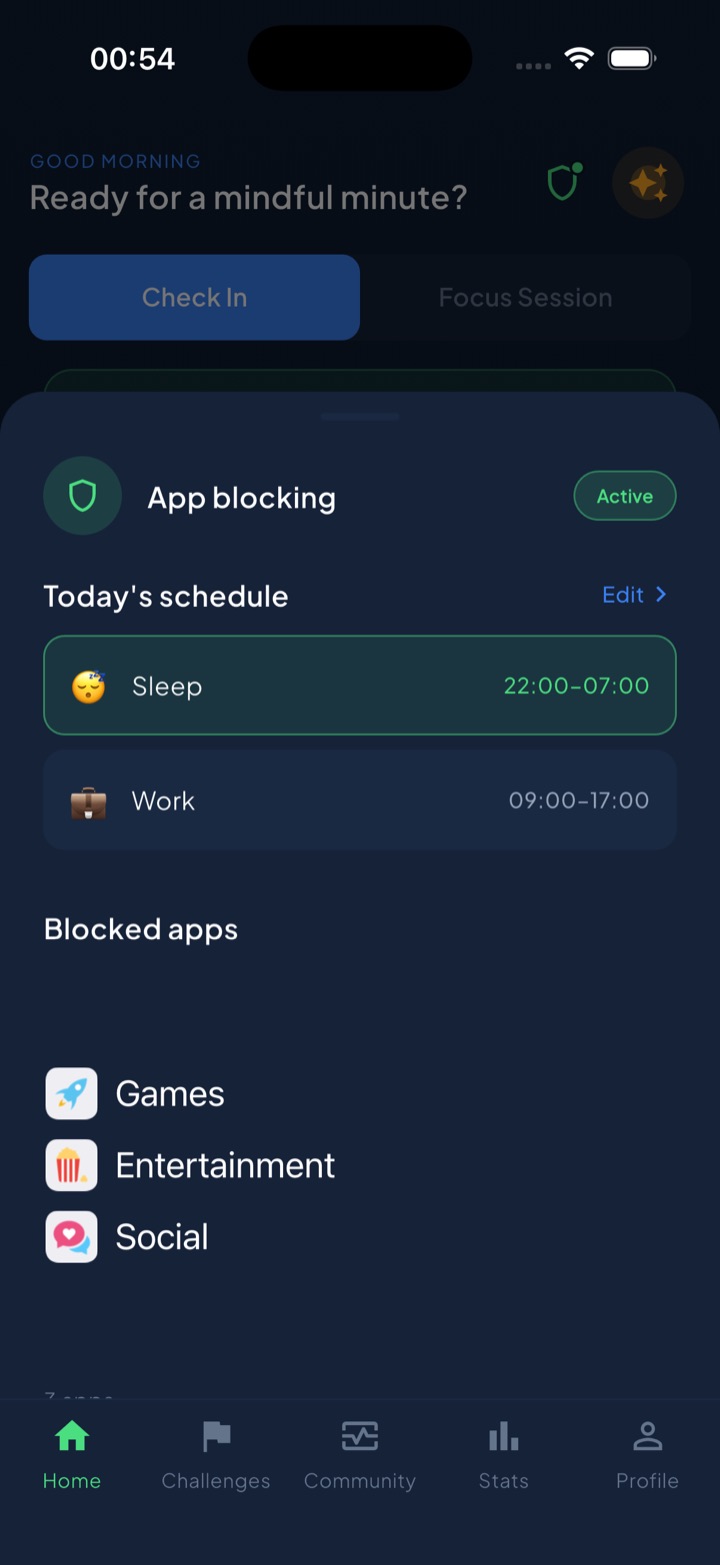
Unscrol is an iPhone and Apple Watch app built around exactly the arithmetic above: fewer hours in the bazaar, less manufactured wanting. You set a daily total (45 minutes by default) and a per-session maximum (5 minutes by default), and iOS enforces both through the Screen Time and FamilyControls frameworks rather than a cosmetic overlay. Spend a session-sized chunk of the budget and the chosen apps lock for 15 minutes; spend the whole daily budget and they lock until tomorrow. The session cap is the one that matters for shopping, because it ends the browse while you can still remember you were not shopping for anything. For the evening hours where impulse buying actually happens, Shield blocks by time of day on a schedule you set, and switching it off mid-block is deliberately slow: a breathing exercise and a wait, not a one-tap escape. A streak counts every day you stay under budget, and home-screen and lock-screen widgets show what is left without you opening anything.
Two caveats, plainly. The usage numbers are estimates, because iOS reports through thresholds crossed across an interval rather than exact minutes, so treat the budget as approximately right. And iOS hands the app opaque tokens rather than app identities: Unscrol cannot see which apps you picked, their names or their icons, the system draws the picker and the app only draws the frame around it, and block lists and usage stay on-device. Free to download, with an optional premium tier adding Streak Saver for a missed day and five concurrent challenge slots instead of one.
Frequently asked questions
What is deinfluencing?
Deinfluencing is content in which a creator tells you not to buy something, usually a product that has been going viral. The format took off in early 2023 as a backlash against haul culture, and it ranges from genuine warnings about overhyped products to straightforward comparison content. Structurally it works exactly like influencing: a person you trust makes a confident claim about a product, and you act on it. The only thing that flips is the direction of the recommendation, which is why so many deinfluencing videos end with a cheaper alternative the creator does want you to buy.
What is underconsumption core?
Underconsumption core is the aesthetic sibling of deinfluencing: videos showing normal, unglamorous amounts of stuff. A single bottle of shampoo used down to the last drop, a five-year-old phone, a wardrobe of eleven items, a kitchen with no gadget wall. It reads as a correction to a decade of feeds where everyone appeared to own forty of everything, and at its best it just shows people what average looks like again. The risk is that it becomes an aesthetic rather than a habit, and an aesthetic can be shopped for, which is how you end up buying matching glass jars to look like someone who does not buy things.
Is deinfluencing actually good for you?
Parts of it genuinely are. It named a real feeling, which is that audiences are exhausted by being sold to hundreds of times a day, and it made skepticism of hauls socially normal instead of stingy. It also proved that not-buying content can hold attention, which matters because the alternative to a purchase video used to be no video at all. What it cannot do is fix the underlying mechanism, because you are still spending the same hours inside a feed that is optimized to make you want things, and the wanting scales with the hours far more reliably than it scales with any individual recommendation.
How do I stop wanting things I see on social media?
Reduce exposure before you try to improve willpower, because desire is manufactured by repetition rather than by decision. The most reliable move is to cap the hours you spend in the apps where shopping content lives, since you cannot be influenced during hours you are not there. Then add a delay rule for anything that survives the cap: if you still remember wanting it two days later, away from the feed, it is a real want rather than an implanted one. Finally, switch from discovery shopping, where you browse and see what appears, to list shopping, where you write the thing down first and go get it.