Nobody online can answer this for you, and that includes this article, but the two possibilities leave different fingerprints. ADHD is real, it is genuinely underdiagnosed in adults, and for a lot of people a stranger’s thirty-second video was the first accurate description of their own head they had ever heard. Heavy phone use also produces a symptom cluster that looks remarkably like it: fragmented attention, tasks you cannot start, hours that vanish, a memory that drops everything you hand it. The useful question is not which one is it, because you cannot settle that by reading. It is what evidence would tell them apart, and there are three lines of it you can gather this month.

Why is my feed so convinced I have ADHD?
Because you paused on it once, and two things are true about what happened next.
The first is that relatability is engineered. Short-form ADHD content is written to describe almost everybody a little. You open a tab and forget why. Your room is messy in a specific way. You have forty unfinished projects and one you did in a single night. Under deadline pressure, bad sleep, or a rough few months, most adults tick most of those boxes. The algorithm did not assess you. It measured half a second of hesitation and served you a thousand more of the same, and a thousand hits in a row feels like proof.
The second is less comfortable. The same feed produces the symptoms it is naming. The video telling you that you cannot sustain attention is being delivered by a system that has spent two years rewarding you for switching every eleven seconds. The thing that made you feel seen and the thing that fragmented you are the same object.
None of that means the recognition was fake. Inattentive ADHD in girls has been missed for decades because it does not look like a boy climbing the furniture, and a great many adults found the right words for themselves on exactly this kind of video and went on to a diagnosis that reorganised their lives. Self-recognition is a legitimate first step. It is a terrible last one.
Can a phone actually cause ADHD?
Not in the sense of giving you the disorder. ADHD is neurodevelopmental, it runs in families, and it begins in childhood whether or not anyone wrote it down. You do not acquire it at twenty-six from an app.
That is a narrower claim than it sounds, though. Researchers following teenagers over time have reported associations between heavy digital media multitasking and later attention difficulties, and there is genuine, unsettled argument about which direction that arrow points. What is far less disputed is the short-range version: a brain fed thousands of high-novelty, no-effort switches a day gets worse at low-novelty, high-effort things. And “worse at low-novelty, high-effort things” is close to a paraphrase of what an ADHD screening questionnaire asks you about. Popcorn brain is the popular name for that state, and why you cannot focus anymore walks through the mechanism.
So a phone can hand you an ADHD-shaped set of complaints without handing you ADHD. It can also make real, pre-existing ADHD considerably worse. Both of those are true at the same time, which is precisely why the question is hard.
What actually tells them apart?
Three lines of evidence. None is diagnostic on its own. Together they orient you.
Timeline. ADHD is lifelong. The useful question is not “have I always been like this”, because nobody remembers accurately and everyone’s memory bends toward whatever they just watched. It is “what does the evidence from before I owned a smartphone say”. A phone-shaped problem starts somewhere in your smartphone years and gets worse in step with your usage.
Context. ADHD travels across settings and eras. It was there in school, in the job you liked, in the summer you spent abroad. A phone-driven attention problem is context-dependent and, critically, it detoxes. Take the input away for a few weeks and it measurably eases. ADHD does not detox away.
Spread. ADHD is not an attention problem wearing a productivity costume. It reaches into domains a screen habit rarely touches: near-misses while driving, money that disappears without a story, paperwork that stays unopened until it becomes a crisis, relationships strained by forgotten arrangements.
| Signal | Points toward ADHD | Points toward a phone pattern |
|---|---|---|
| When it started | Traceable to childhood: school reports, old teachers, family memory | Traceable to your smartphone years, and worse as usage rose |
| Two weeks of real reduction | Helps, but the core pattern is still recognisably there | Improves markedly, often more than you expected |
| Where it shows up | Everywhere: driving, money, admin, deadlines, relationships | Mostly around screens and the tasks that compete with them |
| Focus profile | Inconsistent: four hours of hyperfocus on the interesting thing, and no way to begin the boring one | Uniformly shallow: nothing holds, including things you enjoy |
| Off-screen activities | Novels and long films were hard at fifteen too | Novels and long films were fine until a few years ago |
| Family history | Frequently present in a parent or sibling, diagnosed or not | No particular pattern |
| Who decides | Not this table, and not a video. A qualified clinician, using your developmental history, standardised measures, and a look at the other things that produce identical complaints: sleep apnoea, anxiety, depression, thyroid problems, low iron. | Same. |
How do I get real evidence in two weeks?
Run the reduction as an experiment rather than a resolution. It is the cheapest differential evidence available to you, and it costs nothing but two slightly uncomfortable weeks.
- Cut hard, not gently. A vague intention to use your phone less produces vague data. Pick a real daily budget for the apps that eat you, put a maximum on any single sitting, and let something other than your willpower enforce both.
- Choose three measurable outcomes before you start. Not “focus better”. Ten pages of a novel in one sitting. One ninety-minute work block without switching. Falling asleep within thirty minutes.
- Write down the baseline today, badly and honestly, including your current weekly screen time average. In fourteen days you will not remember what this week felt like.
- Protect sleep at the same time. Sleep debt imitates both conditions well enough to ruin the experiment.
- Do not judge it before day five. The first few days are irritable, bored, and strangely long. That is the shape of the thing leaving, not the answer arriving.
Then read the result honestly, because all three outcomes are informative. If most of it lifts, the phone was carrying more of this than you thought, which does not rule ADHD out but changes what to do first. If sleep and mood improve while the core pattern stands, that gap is exactly the sort of thing worth describing to a clinician. And if two genuinely strict weeks change almost nothing, that is a real finding too, and it points toward an assessment and toward a blood test rather than another app.
“I was about eighty percent sure I had ADHD, entirely from videos. I did two strict weeks before my assessment, mostly so I would have something concrete to say. My sleep and my reading came straight back, and the thing that did not move at all was starting anything boring: I still sat in front of a form for two days. That turned out to be the useful sentence in the appointment. I got diagnosed, and I would never have been able to describe it that precisely without the two weeks.” — Priya, junior architect, 29
What childhood evidence should I look for?
School reports are the best single source, and most parents still have them. You are looking for the recurring adjectives rather than the grades: careless mistakes, chatty, doesn’t apply herself, bright but disorganised, daydreams. Talk to a parent or an older sibling about what you were like at nine, before anyone had a phone to blame.
One caution that cuts the other way. The inattentive presentation is quiet, and quiet children who get acceptable marks are rarely referred. If you held together until the external structure disappeared, at university or in your first job, then an absent childhood diagnosis is not evidence that nothing was there.
What do I do with either answer?
The practical relief is that the two paths overlap early on.
If it is ADHD, get assessed properly, and understand that external structure beats willpower for you by a wider margin than it does for other people. That is not a moral failing, it is the accommodation working as intended, and it is the premise behind app blockers built for ADHD brains. ADHD and phone addiction is the article written for the version of you who already has the diagnosis, and time blindness explains the hours that vanish without a trace.
If it is mostly the phone, the repair is slower and duller than the internet suggests, and it does work: rebuilding an attention span is a matter of weeks of protected, uninterrupted blocks rather than a weekend detox.
And to say it plainly, because it matters: this article is not a diagnosis and cannot be one. It is a way to arrive at an appointment with a timeline, a two-week result, and a school report instead of a feed.
How does Unscrol help?
The honest starting point is that you can run most of this experiment for free. Apple’s Screen Time already gives you a weekly average to use as your baseline, daily App Limits, and Downtime for the hours around sleep. If that is enough to make your two weeks strict, you need nothing else and should not buy anything. Where it runs out is the enforcement: iOS has no per-sitting cap, its limits come with a one-tap dismissal, and it keeps no clean before-and-after record of the fortnight you are trying to read.
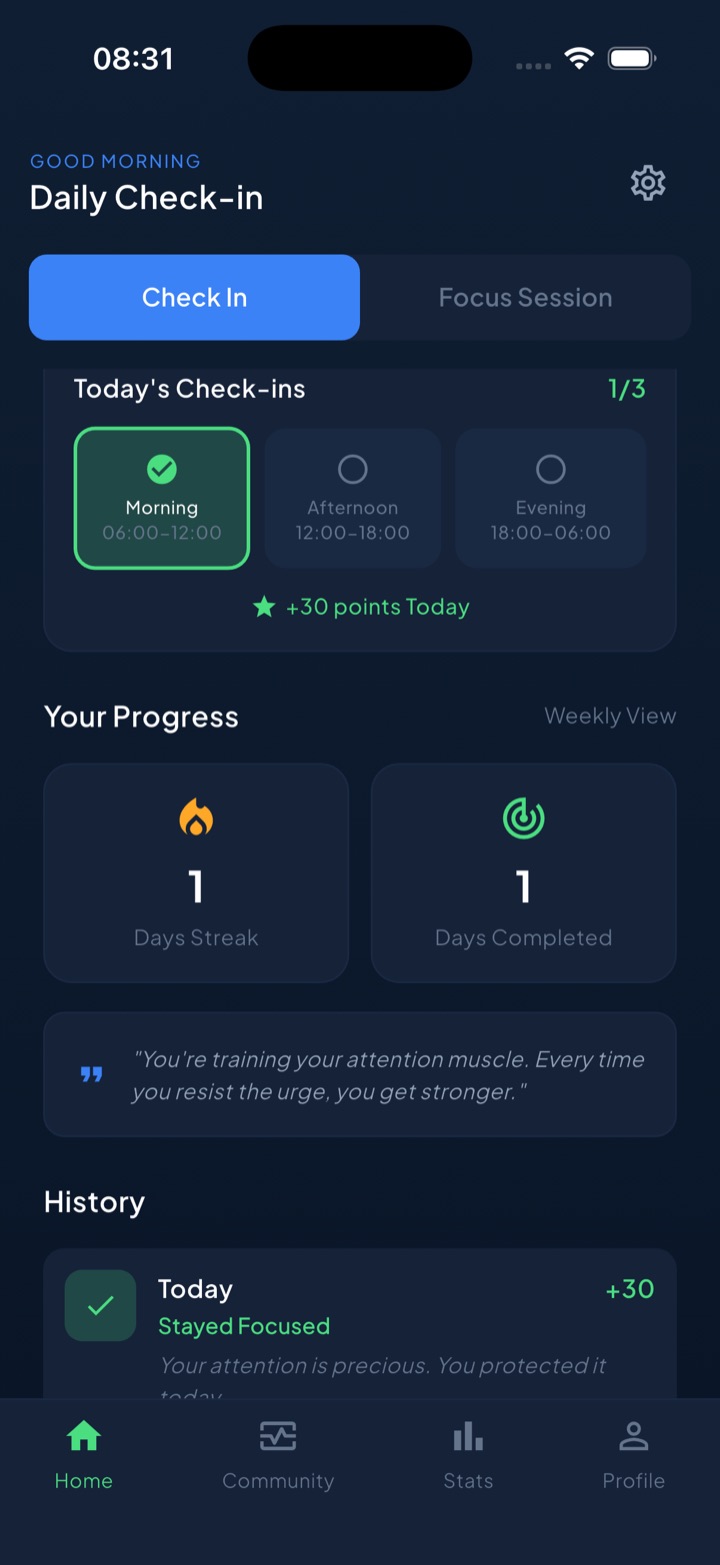
Unscrol is an iPhone and Apple Watch app that works as the instrument for exactly this experiment. You set a daily total (45 minutes by default) and a per-session maximum (5 minutes by default), both enforced through Apple’s Screen Time and FamilyControls frameworks rather than a cosmetic overlay. Spend a session-sized chunk of the budget and the apps you chose lock for 15 minutes; spend the whole daily budget and they lock until tomorrow. Shield adds scheduled blocking by time of day, and switching it off mid-block is deliberately slow, a breathing exercise and a wait rather than a dismiss button. A streak counts every day you finish under budget, which is what makes fourteen days legible as fourteen days instead of a vague impression, and home-screen and lock-screen widgets keep the number in front of you. If the answer turns out to be ADHD, none of that becomes useless: external structure is the accommodation, and it is easier to keep than willpower.
Two caveats, plainly. The usage numbers are estimates, because iOS reports crossed thresholds across an interval rather than exact minutes, so read the budget as approximately right. And iOS hands the app opaque tokens, never app identities: Unscrol cannot see which apps you picked, their names or your per-app usage, and block lists and usage data are processed on-device by iOS and never reach Unscrol’s servers. Free to download, with an optional premium tier adding Streak Saver for a missed day and five concurrent challenge slots instead of one.
Frequently asked questions
Do I have ADHD, or is it just my phone?
Nobody online can answer that, but the two possibilities leave different fingerprints and you can gather the evidence yourself. ADHD is lifelong, so it shows up in childhood records and in eras of your life that had nothing to do with a smartphone. A phone-driven attention problem tracks your usage, and it improves measurably within a few weeks of a serious reduction, which ADHD does not do. ADHD also spreads into places screens rarely reach, such as driving, money, deadlines, and relationships. Bring the timeline, the reduction result, and any childhood evidence to a qualified clinician, because only an assessment settles it.
Can too much phone use actually cause ADHD?
It cannot give you the disorder. ADHD is a neurodevelopmental condition with a strong hereditary component and it begins in childhood, whether or not anyone noticed at the time. What heavy phone use can do is produce an ADHD-shaped set of complaints, which is a different thing: fragmented attention, trouble starting tasks, lost hours, and a working memory that drops things. Researchers studying media multitasking have reported associations with later attention difficulties, and there is honest debate about the direction of that link. Phones can also make genuine, existing ADHD considerably harder to live with, which is exactly why the two questions blur.
Is self-diagnosing ADHD from TikTok reliable?
It is unreliable in both directions, which is the part people miss. The algorithm shows you ADHD content because you hesitated on it, and short-form symptom lists are written to describe almost everyone a little, especially anyone tired, stressed, or coming off a bad month. At the same time, the same feed produces the symptoms it is naming, so feeling recognised proves less than it feels like it proves. None of that makes the recognition worthless. Many adults, women especially, first saw themselves in exactly this way and went on to a real diagnosis that changed their lives, so treat it as a good first step and a terrible last one.
How long does attention take to recover after cutting phone use?
Give it two weeks before you judge anything, and expect the first three or four days to feel worse rather than better. Boredom, irritability, and a strong urge to check are withdrawal-shaped and they pass. Most people notice the easy wins first, such as falling asleep faster and reading more than a page, while sustained concentration on difficult work returns more slowly and unevenly. If two genuinely strict weeks change very little, that is useful information rather than a failure, and it points toward getting assessed and toward ruling out sleep problems, anxiety, depression, thyroid issues, and low iron.