Waking up at 3am is normal. Picking up the phone is the part that wrecks the night. Everyone surfaces briefly between sleep cycles, several times, most nights, and almost always sinks back under within a minute without ever forming a memory of it. The phone converts that ninety-second surfacing into a forty-minute abduction. This is not weakness on your part. At 3am the part of your brain that would say put that down is the part that is still asleep, which makes you the most defenseless scroller you will ever be.

Is waking up in the middle of the night normal?
Yes, and far more normal than the people it happens to tend to believe.
Sleep is not one solid block. It runs in cycles of roughly ninety minutes, and the seam between cycles is a shallow, near-waking place. You cross that seam four or five times a night. Usually you turn over and go straight back under. Sometimes something catches you there and hauls you all the way up.
There is also a decent historical case that the unbroken eight-hour block is a fairly modern expectation. The historian Roger Ekirch found hundreds of references in pre-industrial European texts to a first sleep and a second sleep, with an hour or so of quiet waking in between, when people prayed, talked, tended the fire, or visited neighbours. Whether or not that pattern was universal, the useful part stands: a wake-up at 3am is not a fault report. What happens in the ninety seconds afterwards is the whole story.
Why can’t I resist my phone at 3am?
Because the part of you that does the resisting has not woken up yet.
Sleep inertia is a real, measurable state. Your prefrontal cortex, which handles planning, impulse control and remembering the sensible decision you made at 9pm, comes back online slowly, over something like fifteen to thirty minutes. The systems that respond to novelty, faces, motion and threat are working fine the moment your eyes open. So at 3am you have the full appetite and none of the brakes.
That single fact should reshape all the advice you take. Any plan that requires 3am you to make a good decision has already failed. The interventions that work are the ones you install in daylight, while you are the version of yourself who can think, and they work by making the phone hard to reach rather than by asking you to be strong. This is the same logic behind making your iPhone boring before you need it to be.
What does opening the phone do to the rest of the night?
Two things, and the second is the bigger one.
First, the light. A bright screen twenty centimetres from your face at 3am is a fairly convincing sunrise. Your circadian system is at its most light-sensitive in the middle of the night, so light at that hour does not merely suppress melatonin, it can nudge your body clock, telling the whole system that morning is arriving and it should begin the wake-up sequence hours early. Screen time and sleep covers the mechanism in full.
Second, and worse, the content. Whatever you open, whether it is email or news or a group chat or a feed, is arousing in the physiological sense: heart rate up, attention engaged, a small chemical event per swipe. You have spent three hours descending. Three minutes of feed lifts you most of the way back to the surface, and the whole climb down has to start again. Sleep onset latency for a genuinely activated adult is not five minutes; it is more often twenty to forty-five.
That is where the forty minutes comes from. Two minutes of intended checking, plus the time you actually spent, plus the climb back down.
Why does checking the time make everything worse?
Because the time is never good news, and looking at it starts a calculation you cannot switch off.
The instant you see 3:14 you are doing sleep math. If I fall asleep right now I get three hours and forty-six minutes. The sum arrives uninvited and it is entirely counterproductive: it converts a neutral fact into a performance target with a countdown attached, and performance pressure is the most dependable insomnia generator there is. Then you check again at 3:52, the number has got worse, and now you are behind on a deadline nobody set.
This is why no time-checking is a rule rather than a suggestion. There is nothing you can do with the information. If you do not know it is 3am, it is just dark.
Why do worries feel enormous in the middle of the night?
Because at 3am your defences are down and your context is missing.
A problem you would size correctly at two in the afternoon arrives at 3am stripped of everything that normally keeps it small. There is no daylight, no other people, no to-do list, and crucially no ability to act on it. You cannot call anyone, cannot check anything, cannot test the thought against reality. So it inflates, unopposed, in a very quiet room.
The phone arrives at exactly this moment presenting itself as the solution, and it reliably delivers the opposite.
| At 3am the phone promises | What it actually delivers |
|---|---|
| Just a quick look at the time | Sleep math and a countdown |
| Distraction from the worry | Fresh material, plus the original worry |
| A few minutes until you feel sleepy | Arousal that resets the descent |
| Company in the dark | Other people’s 3am, or nobody at all |
| A route back to sleep | The forty minutes |
If the thing pulling you awake is money, note that the small hours are prime time for doom spending and for opening a portfolio app you have no business opening at 3am.
What actually works when you wake at 3am?
Charge the phone in another room. This is the single highest-leverage change available, and it is not close. It works because it asks nothing of the version of you that is awake at 3am. By the time you have crossed a hallway, your prefrontal cortex has had thirty seconds to boot, and thirty seconds is frequently enough.
If another room is genuinely impossible, across the room is a solid second: far enough that using it requires standing up in the cold. The friction is the mechanism, not the distance.
Buy an alarm clock. A cheap one removes the last honest argument for the phone being on your nightstand. It also gives checking the time an innocent answer, though ideally you turn its face towards the wall so the answer is not actually available.
Adopt the no-time-checking rule. Decide in daylight that between lights-out and the alarm you do not look at the time, on any device, for any reason.
Get up if it has been a while. Standard sleep-medicine advice: if you have been awake somewhere around twenty or thirty minutes, judged by feel rather than by clock, get out of bed, sit somewhere dim, do something dull, and return when you feel sleepy. The point is to stop your brain learning that bed is a place where you lie awake. A paper book under a low lamp is fine. A screen is not.
Note that this is a different problem from scrolling in bed before you fall asleep, which is a bedtime decision made by an awake person who could in principle choose otherwise. The 3am check is made by someone who is barely present, which is why the fix has to be structural rather than behavioural. It is also not revenge bedtime procrastination, where you are staying up on purpose to reclaim an evening the day stole from you.
What do I do lying there in the dark?
Your attention needs somewhere to go that is neither the phone nor the worry.
Slow breathing with a count. Longer out than in, roughly four in and six or eight out, tilts you toward the calming side of your nervous system. The count matters as much as the breath, because it occupies the verbal channel the worry was using.
A body scan. Attention to the toes, then the soles, ankles, calves, knees, all the way up, a few slow breaths on each. Deeply boring, which is exactly the point.
Boring lists. Countries in alphabetical order, every street in the neighbourhood you grew up in, everything in your kitchen cupboards. Feeding yourself a stream of unconnected images is a mild but real technique.
And the reframe that helps most people most: lying quietly in the dark with your eyes closed is not nothing. It is worth considerably more than the same stretch spent scrolling, and dropping the requirement to sleep is often the exact thing that lets sleep arrive.
“I have woken at three most nights since I turned forty. Always the bathroom, always back in bed with the phone in my hand. Check the time, check the work email, and at twenty past four I would still be lying there with my jaw clenched. It charges in the hallway now and I have a twelve-pound alarm clock turned to face the wall. I still wake up. The difference is I no longer know what time it is.” — Diane, hospital ward coordinator, 46
When is waking at 3am worth seeing a doctor about?
Waking briefly and going back down is normal and needs nothing. A few patterns are worth a conversation with a professional:
- Consistent early-morning waking, roughly 3am to 5am, with an inability to get back to sleep, especially alongside low mood, loss of interest, or appetite change. Early waking is a classic depression symptom rather than a phone problem, and it responds to treatment.
- Waking gasping or choking, or a partner reporting that you stop breathing. That points at sleep apnoea and is worth investigating properly.
- Night waking with a racing heart or panic.
- Weeks of daytime function taking a visible hit.
An app is the right tool for the phone half of this. It is not the right tool for any of the above.
How does Unscrol help?
The honest starting point is that Apple gives you a real chunk of this for free. Downtime schedules a window overnight where only the apps you allow will open, and Sleep Focus silences notifications and dims the lock screen. If a scheduled window plus a quiet phone is enough to keep you off it at 3am, you are done and you should not buy anything.
Where the built-in tools run out is the tap. Downtime shows a screen with Ignore Limit on it, and one tap makes it all go away. At 2pm that dismissal is a reasonable escape hatch for an adult with a good reason. At 3am, when you have no prefrontal cortex and no resistance whatsoever, one tap is not a speed bump. It is an open door.
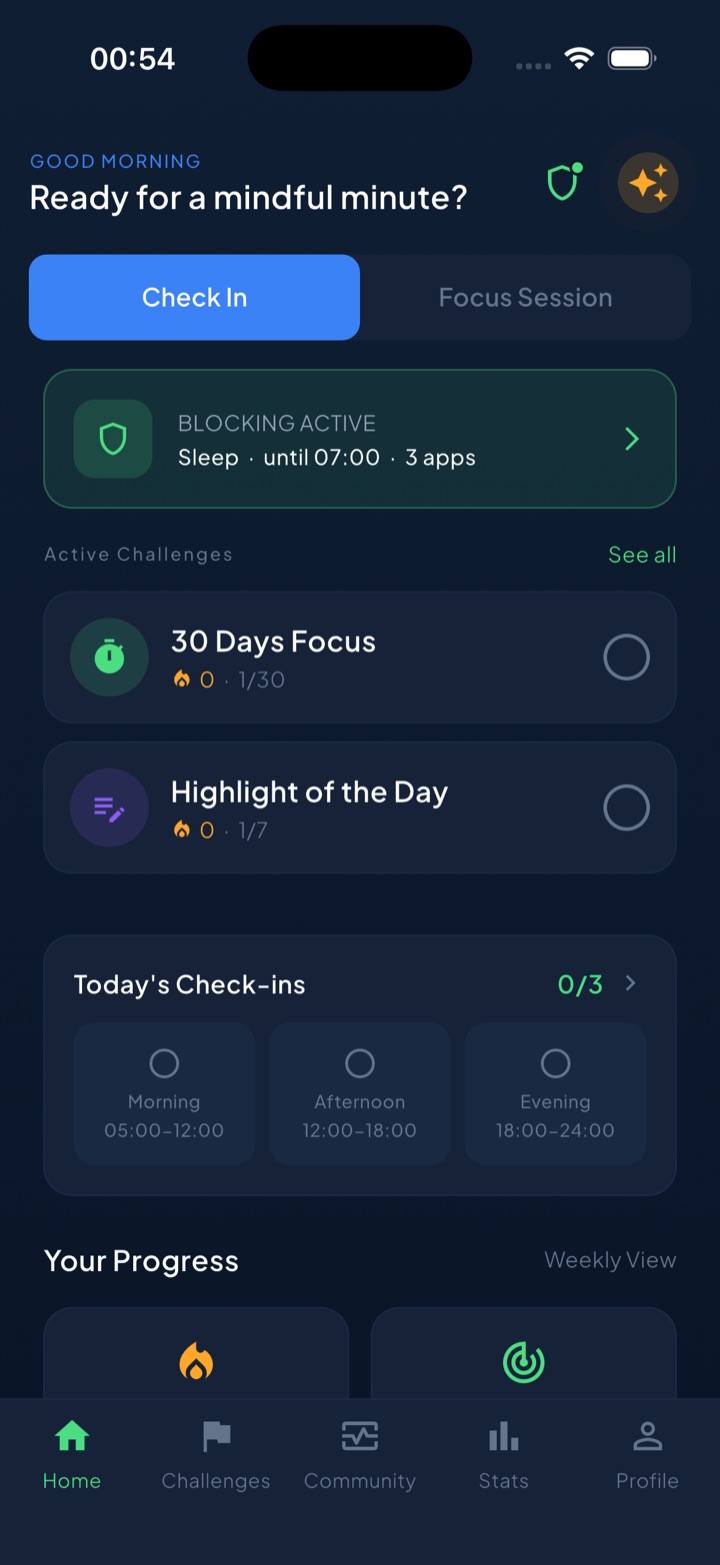
Unscrol is an iPhone and Apple Watch app built on Apple’s own Screen Time and FamilyControls frameworks, so what it blocks is genuinely blocked rather than covered by a cosmetic overlay. Shield is its scheduled blocking: you pick the apps and the hours, set a window across the night, and the 3am tap opens a locked screen and a breathing exercise instead of a feed. Switching Shield off mid-window is deliberately slow by design, a breathing exercise and a wait rather than a single button, and at three in the morning that half-minute of friction is usually the whole intervention. You do not out-argue it, you just put the phone down.
For the daytime half there are two numbers: a daily total, 45 minutes by default, and a per-session maximum, 5 minutes by default. Spend a session-sized chunk of the budget and the apps you chose lock for 15 minutes; spend the whole daily budget and they lock until tomorrow. A streak counts every day you finish under budget, and home-screen and lock-screen widgets show what is left without you having to open anything.
Two caveats, plainly. The usage numbers are estimates, because iOS reports through crossed thresholds across an interval rather than exact minutes, so treat the budget as approximately right rather than accurate to the second. And iOS hands the app opaque tokens instead of app identities: Unscrol cannot see which apps you picked, their names, their icons, or your usage of any one of them. The system draws the app picker; the app only draws the frame around it. Block lists and usage data are processed on-device by iOS and never reach Unscrol’s servers. The app is free to download, with an optional premium tier that adds Streak Saver for a missed day and five concurrent challenge slots instead of one.
Frequently asked questions
Why do I wake up at 3am every single night?
Sleep runs in cycles of roughly 90 minutes, and the boundary between one cycle and the next is a shallow, almost-waking place that you cross four or five times a night. Most of those crossings you never remember, because you turn over and sink back under within a minute. A full bladder, a noise, a partner moving, or a worry that has been queued up all day can catch you at one of those boundaries and pull you fully awake instead. Waking at 3am is therefore not evidence that your sleep is broken. What you do in the next ninety seconds is what decides whether the rest of the night is.
Is it bad to check the time when you wake up in the night?
It is one of the worst small things you can do, because the time is never good news. The second you see the number you start doing sleep math: if I fall asleep right now I get four hours and eleven minutes. That calculation turns a neutral fact into a performance target with a countdown attached, and performance pressure is the most reliable way in the world to stay awake. Then you look again forty minutes later and the number is worse, so now you are behind on a deadline you never agreed to. If you do not know it is 3am, it is simply dark, and dark is much easier to fall back asleep in.
How do I get back to sleep after I have already looked at my phone?
Accept that the descent has been reset and stop trying to force the landing, because forcing it is what keeps you up. Put the phone face down and out of reach, keep the room dark, and give your attention something that is neither the screen nor the worry: slow breathing with a longer out-breath than in-breath, a slow body scan from the toes upward, or a deliberately boring mental list. If you are still clearly awake after what feels like twenty or thirty minutes, get out of bed, sit somewhere dim with a paper book, and go back when you feel sleepy. Lying quietly in the dark with your eyes closed is genuinely worth something, and letting go of the requirement to sleep is often the thing that lets it happen.
Should I keep my phone out of the bedroom completely?
Charging it in another room is the single highest-leverage change available to you, and it works precisely because it does not depend on your willpower at 3am. If another room is genuinely impossible because you are on call, share a small flat, or care for someone at night, then across the room is a solid second best, far enough that using it means standing up in the cold. Buy a cheap alarm clock so the alarm stops being an argument for the nightstand, and turn its face away from the bed so checking the time is not available either. The friction is the mechanism here, not the distance.