Doom spending is what happens when a stress scroll runs all the way to a checkout button. It is doomscrolling’s expensive sibling, and it is trending for a reason: the feeds figured out that an anxious mind is a buying mind, and they built the whole shopping experience around that discovery. You do not decide to spend eighty pounds at 1am. You open an app because the day was bad, you get carried through fifteen minutes of somebody else’s haul, and a countdown timer converts a vague feeling into an order confirmation. The purchase is not the problem you need to solve. The scroll that delivered you to it is.

What exactly is doom spending?
The clean definition: buying to regulate a mood rather than to meet a need. Not a treat you planned and enjoyed. Not a thing you researched for a week. The specific pattern where a bad day ends with a scroll and the scroll ends with a cart.
The reliable tell is not the amount. It is the memory gap. People who doom spend routinely open an email the next morning and feel a small jolt of confusion at their own name on the order. They can usually reconstruct what happened, but they cannot recover the moment of deciding, because there wasn’t really one. There was a feed, a video, a timer, and a thumb.
That gap is the same gap doomscrolling leaves behind. Ask someone what they saw during forty minutes of scrolling and they mostly cannot tell you. Doom spending is that identical trance with a payment method attached, which is why the fix looks much more like a scrolling fix than a budgeting one.
How does a scroll turn into a checkout?
Because the distance between the two collapsed. It used to be a journey: see an ad, remember the brand, visit a site later, decide. Now the ad, the review, the demonstration, the social proof and the payment all happen inside one vertical feed without your thumb changing rhythm.
The machinery is worth naming, because it is easier to resist something you can see working.
Live shopping runs on manufactured urgency. A host counting down, a stock number ticking toward zero, a price that supposedly ends when the stream does. None of those numbers need to be real to work on you, and the format exists specifically because a decision made in eight seconds is a decision made without the part of you that would have said no.
Scarcity language is the load-bearing wall. Only three left, back in stock for one day, this sold out last time. Scarcity does not make you want a thing more, it makes you afraid of the version of tomorrow where you did not get it. That fear is far more actionable than desire.
Creator hauls launder the sales pitch. A person you have watched for months unboxing forty items reads as a friend’s recommendation rather than an ad, and it dissolves your resistance before any product appears. By the time the link is on screen you are not evaluating a purchase, you are continuing a relationship.
The feed learns what your bad days look like. You do not need a conspiracy for this, just an engagement signal. Anxious scrolling looks different from happy scrolling, it lasts longer and converts better, and any system optimising for revenue will find its way to whatever content performs during those sessions. How apps are designed to be addictive covers the rest of that engine.
Why is midnight the most expensive hour of your day?
Three things arrive at once, and the retailers know it.
Your control is at its daily minimum. After a full day of decisions the capacity to refuse one is measurably depleted. Everything you successfully declined at 3pm you will decline less successfully at midnight, and that has nothing to do with your character.
You are up on purpose, and slightly resentful. Revenge bedtime procrastination is the very common habit of staying awake to reclaim hours the day took from you. That mood is specifically vulnerable to shopping, because buying something is the fastest available way to feel like the day gave you something back.
The friction is gone. Face ID, a saved card, an address on file. The interval between the impulse and the irreversible act is now shorter than the interval between a thought and speaking it aloud. Nothing in that chain is designed to let you reconsider.
Stack them and the arithmetic is unkind. Two unplanned forty-pound orders a month is not a crisis in any single month, and it is nearly a thousand pounds a year that bought you no remembered pleasure at all.
Am I overspending, or am I overscrolling?
Most advice about impulse buying works on the money. The money is the symptom.
| Money-side fix | Scroll-side fix | |
|---|---|---|
| What it touches | The checkout | The hour before the checkout |
| When it acts | After you have chosen the thing | Before you ever see the thing |
| Typical move | Budget app, spending alert, unfollow brands | No shopping feeds after 10pm |
| How it feels | Being told no, repeatedly | Never being asked |
| Fails when | You want it enough to move money around | You need the feed for work |
| Best for | Large planned purchases | Small carts you cannot remember |
The row that decides it is the third from the bottom. A budgeting fix asks your least resourced self to win an argument at the worst possible hour, over and over, and it only has to lose occasionally. A scroll fix removes the argument, which is the whole case for designing your environment instead of relying on willpower. You are not more disciplined at 1am with the shopping feed closed. You are simply not being asked.
There is also a straightforward reason to expect the scroll fix to carry the money: nobody doom spends without doom scrolling first. Cut the input and the output goes with it.
“I was tracking every purchase in a budgeting app and it changed nothing, because by the time an expense showed up there it had already happened. The week I actually looked, eleven of my thirteen unplanned orders were placed between eleven at night and one in the morning, all of them straight out of the same app. I stopped trying to spend less. I just made the shopping apps unavailable after ten, and the spending fell off a cliff without me deciding anything.” — Maya, junior account manager, 26
What actually stops it?
Four changes, in the order of how much they return for the effort.
Put an evening wall around the shopping apps and the feeds that sell. Not a reminder, not a screen time report, an actual block that starts before your bad hour rather than during it. Ten in the evening is the usual right answer. Include the social apps, not only the retail ones, since the shopping now happens inside the social apps. If those feeds are also what keeps you awake, stopping the scroll in bed is the same intervention wearing a different hat.
Delete every saved card and turn off autofill. Five minutes of work, and it inserts about ninety seconds between wanting and owning. Ninety seconds kills a startling proportion of these purchases, because the impulse was never strong enough to survive being noticed.
Keep a cooling-off list. When you want something at midnight, write it down instead of buying it. Look at the list on Saturday. Most people report buying somewhere between a fifth and a third of what is on it, and feeling entirely neutral about the rest. The list is useful precisely because it does not feel like denial: you are not refusing, you are postponing, and the postponement does all the work.
Track the correlation for one week. Write down the time and the app for every unplanned purchase. One week is enough. Almost everyone finds the same shape, which is that the spending is not spread across the day at all but clustered into one app and about two hours. Knowing which two hours makes the first fix precise rather than general, and seeing the pattern in your own handwriting does something that reading about it does not. If you want the mechanism underneath all of this, dopamine and social media explains why anticipation, not the parcel, is the part you are chasing.
How does Unscrol help?
The honest starting point: Apple already gives you a usable version of this for free. Screen Time lets you set daily App Limits per app or category and schedule Downtime windows, and it will show you a real weekly average so you can find your own bad hour. If a downtime schedule over your shopping apps is enough to stop the midnight orders, use it and buy nothing. Where it runs out is enforcement and depth: App Limits are a cumulative daily total that arrives long after your first scroll, and Apple’s own documentation notes that limits can be ignored once reached, so the block ends in a single tap at exactly the moment you are least equipped to refuse.
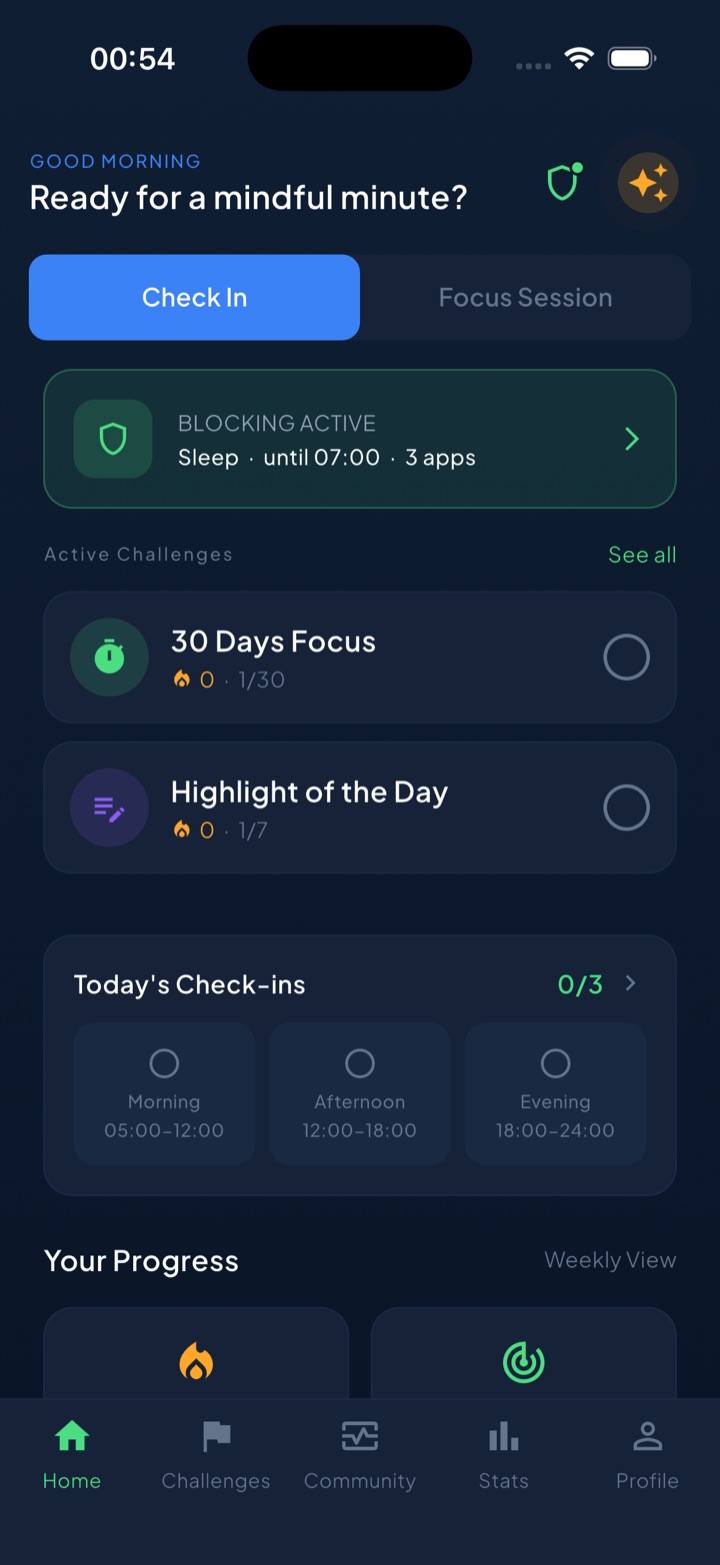
Unscrol is an iPhone and Apple Watch app built on Apple’s Screen Time and FamilyControls frameworks, so the blocking is enforced by iOS rather than drawn as an overlay you can swipe away. For doom spending the relevant piece is Shield, which is scheduled blocking by time of day: pick the shopping and social apps, set the window to start at ten in the evening, and they are simply not there during the hours your money leaves. Switching a Shield off mid-block is deliberately slow, a breathing exercise and a wait rather than a one-tap dismissal, which reintroduces the pause that one-tap checkout removed.
Alongside the schedule there are two limits for the rest of the day: a daily total (45 minutes by default) and a per-session maximum (5 minutes by default). Spend a session-sized chunk of the budget and the chosen apps lock for 15 minutes; spend the whole daily budget and they lock until tomorrow. A streak counts every day you finish under budget, and home-screen and lock-screen widgets show what is left without you opening anything.
Two caveats, plainly. The usage numbers are threshold-based estimates, because iOS reports crossed thresholds across an interval rather than exact minutes, so treat the budget as approximately right rather than precise. And iOS hands the app opaque tokens instead of app identities: Unscrol cannot see which apps you picked, their names or their icons, the system draws the picker and the app only draws the frame around it, and your block lists and usage stay on your device rather than reaching any server. Free to download, with an optional premium tier adding Streak Saver for a missed day and five concurrent challenge slots instead of one.
Frequently asked questions
What is doom spending?
Doom spending is buying things to manage anxiety rather than to meet a need, usually while scrolling a feed that is designed to sell. It is the same behaviour as doomscrolling with a checkout button attached: the scroll starts as a way to avoid a bad feeling, and somewhere in the middle of it a purchase becomes the thing that finally produces a hit of relief. The tell is not the amount spent but the memory gap, because people who doom spend often cannot recall deciding to buy the thing that arrives three days later. It tends to spike during periods of stress, financial pessimism or overwork, which is exactly when the money is least available.
Why do I only shop online late at night?
Because late at night you have the least self-control and the most exposure. Decision-making capacity is measurably worse at the end of a long day, and if you are also staying up on purpose to reclaim some free time, you are scrolling in the exact state that makes an impulse hardest to refuse. At the same hour the feeds are running their most aggressive formats, because retailers know when their conversion rates peak. Add a saved card and a one-tap checkout and the gap between the impulse and the purchase drops to under two seconds, which is far too short for second thoughts.
Does removing my saved cards actually stop impulse buying?
It stops a surprising amount of it, because most late-night purchases do not survive the ninety seconds it takes to find a physical card and type sixteen digits. The point is not that typing a card number is hard, it is that the pause gives you a moment of clarity that a one-tap checkout deliberately removes. Expect it to catch the small unplanned buys rather than the ones you genuinely want, which is exactly the right filter. Removing saved payment details from shopping apps and turning off browser autofill takes about five minutes and is the single highest-yield change most people can make.
Is doom spending the same as a shopping addiction?
Not necessarily, and the distinction matters. Compulsive buying disorder is a clinical pattern involving persistent preoccupation, escalation, and significant distress or financial harm, and it deserves real support rather than an app setting. Doom spending is a much more common and much milder pattern that most people can interrupt by changing when and where they encounter shopping content. If your spending is causing debt you are hiding, or you feel unable to stop despite serious consequences, that is worth talking to a professional about rather than solving with a screen time limit.