Pick one day, put the phone in a drawer, and do it again next week. That is the whole method. A digital sabbath — a tech shabbat, a screen-free Sunday, whatever you end up calling it — is one fixed window a week with the screens off, repeated indefinitely. It has no end date and it asks nothing of you on the other six days. That is exactly why it survives when the heroic version does not: a 30-day detox is a diet, and a sabbath is a meal schedule. One is an event you recover from. The other is a rhythm you live inside.

Why is a weekly screen-free day suddenly everywhere?
It leaked out of the industry. The phrase most people use, tech shabbat, comes from the filmmaker Tiffany Shlain, whose household has switched everything off for 24 hours a week since 2010 — long enough that it stopped being an experiment and became furniture. What spread was not the ideology but the fact underneath it: people who understand precisely how the feeds are built were choosing, every single week, not to be inside them.
There is a status element too, worth naming honestly. Being reachable at all hours used to signal that you mattered; it now signals the opposite, and I’m offline on Saturdays has become a way of announcing that your attention is not a public utility. Underneath the fashion it also happens to be a genuinely good idea, which is rarer than it sounds.
The plainest argument is arithmetic. Change nothing and you have another six months of seven-day screen weeks ahead of you: twenty-six weekends in which the phone was in the room for all of it. A weekly sabbath converts twenty-six of those days into days you will actually be able to describe afterwards.
Why does one day a week beat a 30-day detox?
Four reasons, and none of them are about willpower.
The finish line is always visible. On day nine of a 30-day detox you are staring at three more weeks of the same. On a sabbath, the longest you are ever asked to hold out is until tomorrow morning. Almost nobody quits something with the end already in sight.
Rhythm outlasts effort. A detox runs on motivation, which is a depleting resource. A sabbath runs on the calendar, which is not. After a month or so you stop deciding anything at all — the day simply arrives already spent, the way Sunday lunch arrives.
It is family-compatible. A 30-day detox is something you do to the people you live with. You become the household member who cannot look anything up, for a month, with no warning about when normal service resumes. One day a week is something you do with them, and because it is fixed, it is the only version anyone else can plan around.
The effect compounds sideways. This is the part people do not anticipate. The day off teaches you what the phone was displacing on the other six days. Somewhere around three in the afternoon you will notice that you used to fill this exact slot with nothing you can name. That piece of information changes your Tuesday, not just your Saturday.
If you have already burned out on the heroic version, a 30-day social media detox is worth reading for the contrast. It works while it runs. The failure is almost always in the re-entry.
Digital sabbath vs 30-day detox: which one survives real life?
| 30-day detox | Weekly digital sabbath | |
|---|---|---|
| Shape | An event with an end date | A rhythm with no end |
| Runs on | Motivation | The calendar |
| Longest stretch asked of you | Thirty days | Until tomorrow morning |
| Effect on your household | Something you do to them | Something you do with them |
| What happens afterwards | Re-entry, often a rebound | Nothing. It is next Saturday. |
| Failure mode | One slip ends the whole run | A skipped week is just a skipped week |
| Best for | Breaking one specific app habit fast | Getting a life back permanently |
The row that decides it is the failure mode. A 30-day run is a streak, and streaks are brittle: miss day nineteen and most people abandon the whole thing rather than continue a broken count. A sabbath cannot break, because the unit is a week rather than a chain. Miss one and the next one is already scheduled, which removes the single most common reason detoxes end.
What rules make a screen-free day actually survivable?
Five, and every one of them is about removing a decision in advance rather than winning it in the moment.
The phone goes in a drawer, not in your pocket. A phone that is merely switched off but still against your leg is a phone you will switch back on, because the cost of checking is two seconds. Put it in a drawer, in a room you are not sitting in. The distance is the entire mechanism.
Keep a paper list for the things you will need to look up. You will feel an urgent need to check roughly a dozen things. Write each one on a notepad on the kitchen counter instead. By Sunday morning nine of the twelve are dead, and reading that list is the most persuasive argument for the practice that exists.
Print the day’s logistics the night before. Addresses, directions, the film time, the recipe, the numbers of anyone you are meeting. Almost every failed sabbath fails at the first small logistical obstacle, and that obstacle is always something a thirty-second lookup would have solved.
Keep one dumb fallback for real emergencies. A landline, a partner’s phone, an old handset that only makes calls. The point is removing the feed, not becoming unreachable if a school calls — and knowing a genuine emergency can still reach you is precisely what lets you stop checking for one.
Plan the alternative before the day starts. An empty screen-free day is just a boring day, and boredom is the strongest argument your phone will ever make. Decide on Friday evening what Saturday actually is — a lake, a market, a long lunch, a bike. Things to do instead of scrolling is a list to steal from, and walking without your phone is the easiest place to start, because it needs no equipment and no plan.
What do I do about the kids?
Same deal, same day, and the alternative gets planned first.
What fails is announcing a screen-free day to a child at nine in the morning on the day itself with nothing to replace it. What works is the reverse order: the plan exists first, the day is named after the plan, and the screens being off is a side effect rather than the headline. Saturday is the lake lands. Saturday is no iPad does not, and it invites a negotiation you will lose.
Two details matter more than the rest. Adults have to be visibly subject to the same rule — a parent who confiscates a tablet while holding a phone has taught their child that rules are about power rather than about attention. And it should be the same day every week, for the same reason a phone-free family dinner works: repetition turns it into furniture, and furniture does not get argued with.
What do the first four weeks feel like?
Predictably bad, and then suddenly not.
Weeks one and two are withdrawal. They are worse than you expect. You will reach for an empty pocket somewhere between forty and eighty times, and at some point in the early afternoon there will be a stretch that feels genuinely long and faintly panicky. That feeling is a day being handed back to you at full length, and you have probably not had a day at full length in years.
Week three is boredom, which is a different and much more useful sensation. Withdrawal is the hand reaching. Boredom is the mind, finally unoccupied, starting to produce things — plans, ideas, an urge to fix something in the house.
Week four is the one you start defending. Something shifts around the fourth repetition: an invitation lands on that day and you decline it without deliberating. That is the moment it stops being a restriction and becomes an appointment.
“I tried a thirty-day detox twice and quit both times around day eleven, and both times I came back worse than I started. One day a week was almost insultingly easy by comparison. The first two Saturdays I was awful to be around. Now it is the only day of the week my kids ask about on a Wednesday, and I have started to notice how much of Tuesday I used to spend on absolutely nothing.” — Marcus, operations manager and father of two, 41
What if I am on call and cannot disappear for 24 hours?
Then do the half-day, and do it properly.
A six-hour window that genuinely happens every week beats a 24-hour one you cancel twice a month. Pick a block with a hard edge — from waking until two in the afternoon, or from six in the evening until sleep — and keep it identical every week. The fixed part matters considerably more than the length. A movable sabbath is not a sabbath, it is an intention.
And if your real constraint is being reachable, separate the two things you are conflating. Being reachable is a phone that rings. Being online is a feed. Leave the handset face down in another room with everything silenced except calls from three named people, and the on-call requirement is satisfied without the feed coming along for the ride. The half-day version pairs naturally with a phone-free morning routine, since the first hours of the day are the easiest to defend, and the digital detox guide is the wider map of the other formats.
How does Unscrol help?
The honest starting point: Apple already gives you a usable version of this for free. Screen Time’s Downtime can be scheduled, and you can set it to cover a whole day — every Saturday, all day, with only the apps you explicitly allow left available. If that alone is enough to make your sabbath happen, you are finished and you should not buy anything. Where the built-in version runs out is the same place it always does: when Downtime blocks an app, the block ships with a one-tap dismissal, and a sabbath is precisely the situation where one tap at ten in the morning ends the whole day.
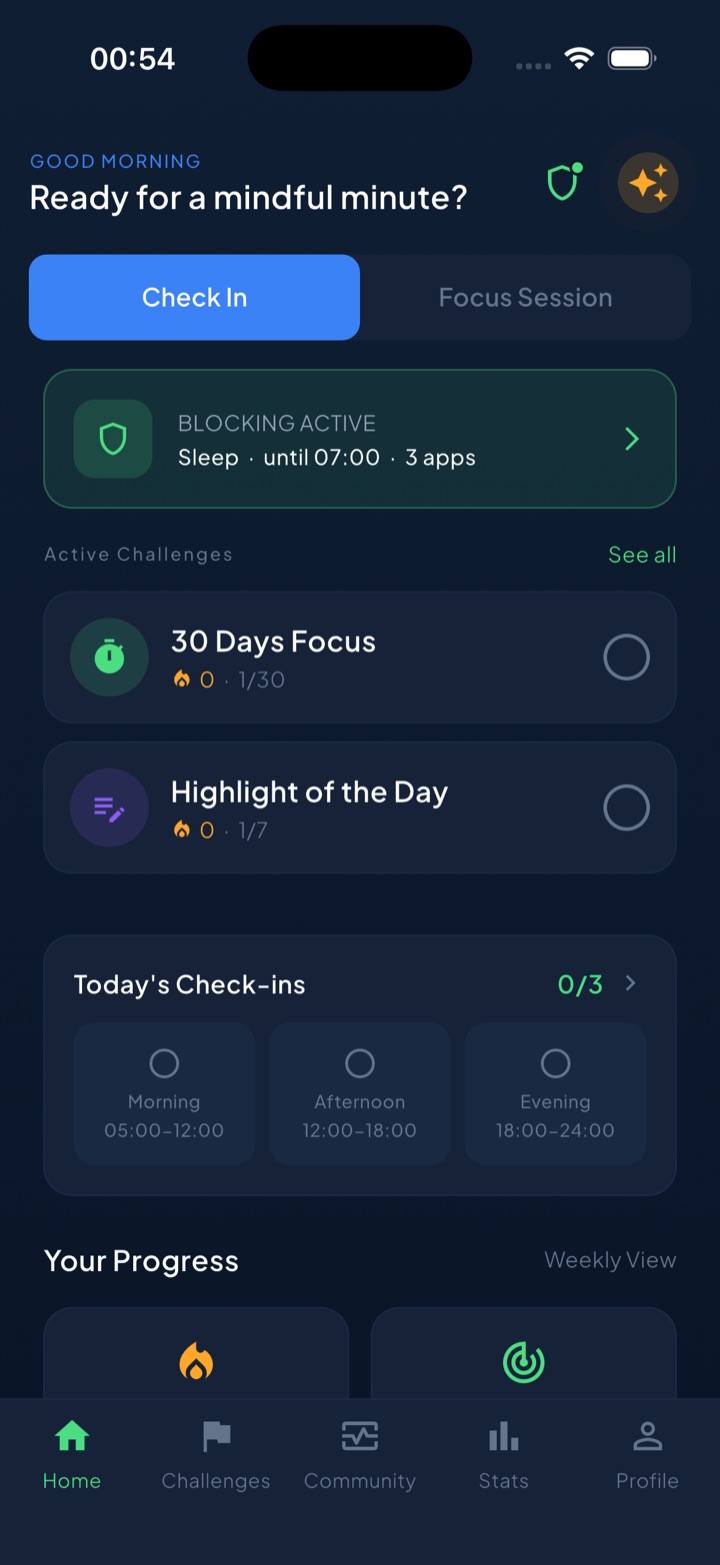
Unscrol is an iPhone and Apple Watch app built on Apple’s own Screen Time and FamilyControls frameworks, and the feature that matters here is Shield: scheduled blocking by time of day. Set a recurring window across your sabbath and the apps you chose simply stay shut for its duration — not hidden, not discouraged, shut. Turning Shield off in the middle of a block is deliberately slow, a breathing exercise and a wait rather than a single tap, which is exactly the friction a rest day needs at the moment you most want to break it. Outside the sabbath the same app runs the ordinary numbers: a daily total (45 minutes by default) and a per-session maximum (5 minutes by default), where a session-sized chunk of the budget locks the chosen apps for 15 minutes and the full daily budget locks them until tomorrow. A streak counts each day you stay under budget, and home-screen and lock-screen widgets show where you stand without you opening anything.
Two caveats, plainly. The usage numbers are estimates, because iOS reports crossed thresholds across an interval rather than exact minutes, so treat the budget as approximately right rather than accurate to the second. And iOS hands the app opaque tokens rather than app identities: Unscrol cannot see which apps you picked, their names or their icons, and your block lists and usage data are processed on-device by iOS and never reach Unscrol’s servers. The system draws the app picker; the app only draws the frame around it. Free to download, with an optional premium tier adding Streak Saver for a missed day and five concurrent challenge slots instead of one.
Frequently asked questions
What is a digital sabbath?
A digital sabbath is one fixed window each week, usually 24 hours, in which you do not use screens, repeated indefinitely rather than run as a challenge with an end date. The term tech shabbat borrows the shape of a religious rest day without requiring the religion: the same day every week, the same start time, no negotiation about whether this week counts. Most people run it from Friday evening to Saturday evening or across a full Saturday or Sunday, and most keep a non-smart fallback such as a landline for genuine emergencies. The defining feature is not the length but the repetition, because a day that recurs stops costing you a decision.
Is a weekly screen-free day better than a 30-day detox?
For most people, yes, because it survives contact with normal life. A 30-day detox is powered by motivation and breaks permanently the first time you slip, while a weekly sabbath is powered by the calendar and simply resumes the following week if you miss one. The longest stretch a sabbath ever asks you to hold is until tomorrow morning, which is short enough that the finish line is always visible. A detox is still useful for breaking a specific app habit fast, but the weekly version is what people are still doing two years later.
What do you do all day without your phone?
You decide the night before, which is the part everybody skips. An unplanned screen-free day is just a boring day, and boredom is the strongest argument your phone will ever make, so the alternative activity needs to exist before the day starts. Anything with a location and a duration works well: a walk, a market, a swimming pool, a long lunch, a bike ride, a book you have been carrying around for months. Write the day's logistics down on paper the night before, including addresses and any phone numbers you might need, so the first obstacle does not send you straight back to the screen.
How long does a digital sabbath take to get used to?
Roughly four weeks, with a predictable shape. The first two are withdrawal and are worse than most people expect: you will reach for an empty pocket dozens of times and hit a stretch in the afternoon that feels uncomfortably long. The third week trades withdrawal for ordinary boredom, which is less unpleasant and considerably more useful. The fourth is usually the one where somebody invites you to something on that day and you decline without thinking about it, which is the point at which the day has become an appointment rather than a restriction.