You can absolutely reset it, and the reset genuinely works for about a week. The Not Interested taps, the unfollow purge, the cleared watch history: all of it moves your feed, sometimes within a day. What nobody mentions is that a recommender rebuilds itself out of whatever you do next, and the version of you doing the rebuilding is usually tired, up too late, and thumbing past everything except the one video that made you angry. The cleanse is real. It is the maintenance that fails.

Why is my feed suddenly so bad?
Because two things went wrong at the same time and they multiplied each other.
The first is supply. Producing a plausible video, a convincing fake screenshot or a confident thread about nothing now costs almost nothing, so the volume of content built purely to hold attention has grown faster than the volume of content built to be good. A lot of it is generated, and generated content is optimised for the metric on the first try, because there is no author with taste getting in the way.
The second is that ranking systems do not grade quality. They grade retention. Nothing in the pipeline can read a video and decide it is worth your evening. It can only observe that people like you kept watching, and promote accordingly.
Put those together and notice the shape of what got worse. It is not random noise. It is rage bait, doom, cringe, engagement farms and ads for a thing you looked at once. Those categories did not win because they are popular. They won because they are hard to look away from, which is the only thing being measured.
Is the algorithm showing me who I really am?
This is the joke everyone makes, that the algorithm knows them better than their friends do, and it is a flattering misunderstanding of what is happening.
Your feed is a mirror of your dwell time, not your taste.
There is no field anywhere in the system for whether you endorsed something. There is no way to record that a video was beneath you, or that you watched it while feeling worse and worse. What gets recorded is duration, replays, whether you paused, whether you opened the comments, whether you came back. A clip you love and a clip that makes you furious produce a nearly identical trace. So the system, working exactly as designed, treats them as the same request and sends more of both.
Which means the feed is not a portrait of you. It is a portrait of your least-defended twenty minutes, extrapolated. You trained it at midnight, in a queue, in the ten minutes after an argument, on the days you had nothing left. Then it showed you the result at nine the next morning and you concluded that this is what you are into.
How apps are designed to be addictive covers the mechanics underneath that loop, and what brain rot actually is covers what a long diet of it feels like from the inside.
How do I reset my TikTok or Instagram algorithm?
Six moves, ordered by how much signal each one actually carries. The first is worth more than the rest combined and nobody does it.
Stop paying in seconds. Watch time is the currency, so spend it deliberately. Swiping past something within a second or two is a clean negative signal and it costs you nothing. The genuinely expensive mistake is the hate-watch: pausing on something stupid, replaying it to show someone, opening the comments to check that other people are annoyed too. That is a strong positive vote submitted by accident.
Long-press hygiene. Every major feed has a per-item control buried behind a long press or the three dots: Not Interested, Hide, Not relevant. Use it on everything you dislike, not just the worst offenders, for about a week. Individually these signals are weak. In volume over a few days they are the fastest legitimate steering wheel you have.
Purge the follows. Sort your following list by who you have not enjoyed in months and cut without ceremony. Following is a permanent standing instruction to keep this in the running, and most people’s lists are a fossil record of who they were four years ago.
Search-seed what you want. This is the most underrated move on the list. Recommenders hate vacuums, and if you only ever tell a feed what you dislike, it will refill the space with whatever is broadly engaging, which is where the slop lives. Search three or four topics you actually want more of, watch a few of those to completion, follow two accounts in each. You are not just removing, you are giving it something else to do.
Mute the words. Keyword and hashtag muting is unglamorous and it works, especially for the recurring news cycle or discourse that reliably ruins your mood.
The nuclear option. TikTok has a genuine reset under Settings, Content preferences, Refresh your For You feed. YouTube lets you clear or pause watch and search history, which is close to the same thing. Instagram has no true equivalent, so a fresh account is the honest version there.
| Reset move | How fast it bites | Effort | Lasts? |
|---|---|---|---|
| Swiping past fast | Immediate, cumulative | None once it is a habit | Yes, while you keep doing it |
| Not Interested taps | 2 to 4 days | High for a week | Yes, if follows change too |
| Unfollow purge | Immediate for followed content | One sitting | Yes |
| Search-seeding new topics | 1 to 3 days | One sitting | Yes, and it fills the gap |
| Clearing watch history | Hours | One tap | No, decays fastest of all |
Does clearing your watch history actually work?
Yes, and faster than people expect. That is also the trap.
A recommender with no signal cannot personalise, so it falls back to the global default, and the global default is whatever holds the most people the longest. That is the exact rage bait and generated slop you were trying to escape, now served to you without even the courtesy of being about your interests. A blank slate is not a good feed. It is a loud one.
So the hour after a nuclear reset is the most valuable hour you will get. Whatever you watch in it becomes the new baseline, and the model is at its most impressionable precisely because it knows nothing. Go in with a list. Search your four topics, follow the accounts, watch those to the end and swipe past everything else fast. Do the cheap work first and the reset last, not the other way around.
Why does my feed get bad again a week later?
Because you reset the model and kept the behaviour that built it.
Wipe your For You page on Sunday, then scroll the same seventy minutes a day in the same conditions, and by the following weekend you will be looking at a recognisable version of the feed you deleted. The inputs did not change, so the output reconverged. Nothing malfunctioned.
The specific culprit is the late session. Between eleven at night and two in the morning you are not curating anything. Filtering takes effort, and by then there is none left, so you watch what holds you rather than what you chose, and you hand over a dense uninterrupted block of exactly the signals you spent the weekend deleting. One bad night undoes a lot of Not Interested taps, because it is longer and more continuous than any of them. This is the same dynamic behind doomscrolling, and the reason short-form video reshapes attention so quickly in the first place.
“I did the full cleanse in January. Cleared everything, unfollowed about three hundred accounts, spent an evening tapping Not Interested. For maybe ten days it was genuinely nice. Then it came back, and I could not work out what I had done wrong. Nothing, was the answer. I was still scrolling until two in the morning, so I was just teaching it the same thing again from scratch. The thing that actually held was cutting the night sessions.” — Marcus, junior architect, 26
So the honest framing is this: less data and calmer sessions are the only durable cleanse. A shorter session gives the recommender fewer samples to learn from, and the samples it does get come from a version of you that is still choosing. Fewer inputs, slower drift. It is not as satisfying as a purge, but it is the only part that compounds. Cutting the depth of a session matters more than cutting the count, which is also why stopping reels is mostly a problem of session length.
How does Unscrol help?
The honest starting point: Apple gives you most of the raw material for free. Screen Time will show you a real weekly average per app, let you set daily App Limits, and schedule Downtime so the feed is simply unavailable at the hours when you were doing the worst of the training. If a nightly Downtime window is enough to keep your reset from decaying, you do not need anything else and should not buy anything. Where the built-in tools run out is the shape of the session: iOS has no per-sitting cap, so a 45-minute daily budget can still be spent as one uninterrupted 45-minute block, which is precisely the block that retrains the feed.
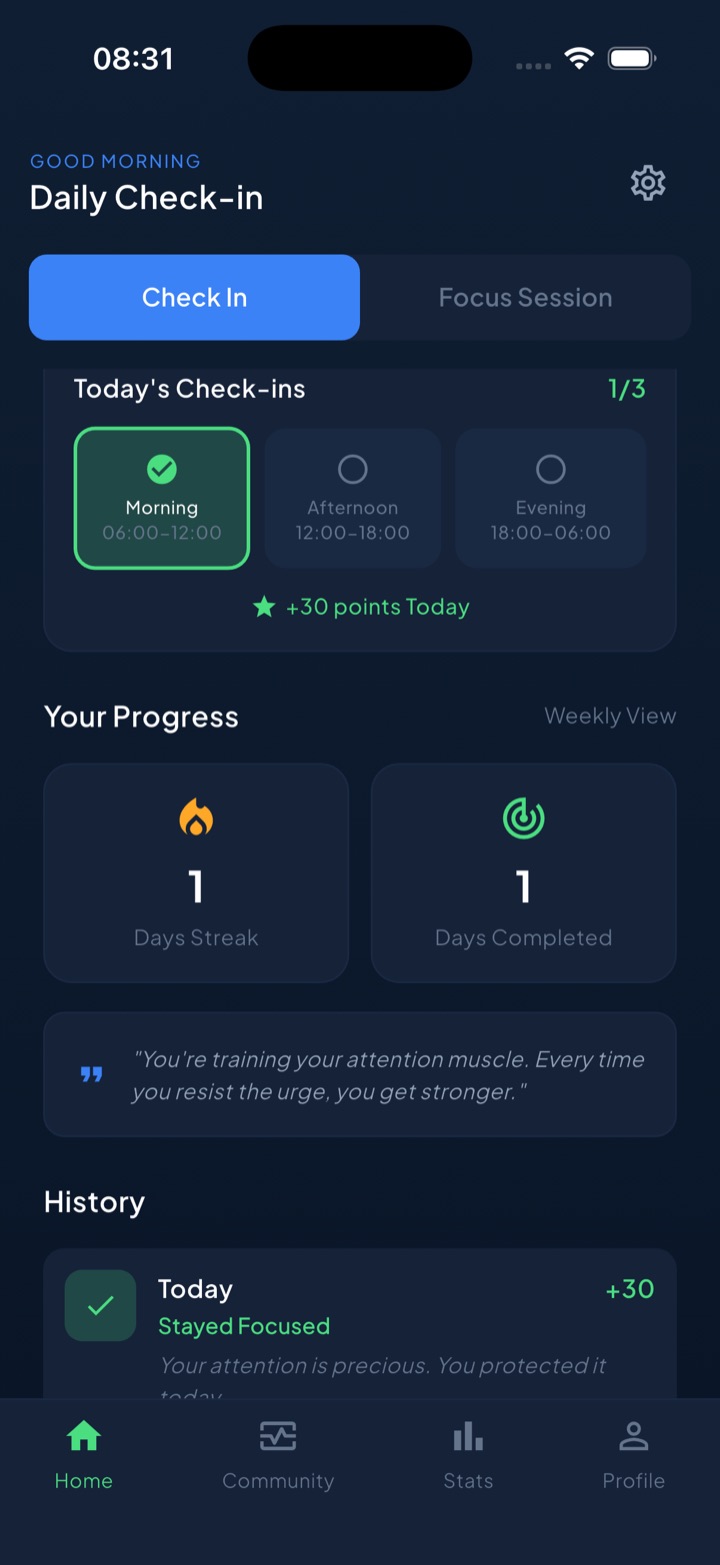
Unscrol is an iPhone and Apple Watch app built around the two numbers that decide how much training data you hand over. You set a daily total (45 minutes by default) and a per-session maximum (5 minutes by default), and iOS enforces both through the Screen Time and FamilyControls frameworks rather than a cosmetic overlay. Spend a session-sized chunk of the budget and the chosen apps lock for 15 minutes; spend the whole daily budget and they lock until tomorrow. Shield handles the placement problem: scheduled blocking by time of day, so the 1am window can simply not exist, and switching it off mid-block is deliberately slow, a breathing exercise and a wait rather than one tap. A streak counts every day you finish under budget, and home-screen and lock-screen widgets show what is left without you opening anything.
Two caveats, stated plainly. The usage numbers are threshold-based estimates, because iOS reports crossed thresholds across an interval rather than exact minutes, so treat the budget as approximately right rather than precise to the second. And iOS hands the app opaque tokens instead of app identities: Unscrol cannot see which apps you picked, their names or their icons. The system draws the picker, the app only draws the frame around it, and block lists and usage stay on-device. Free to download, with an optional premium tier adding Streak Saver for a missed day and five concurrent challenge slots instead of one.
Think of it as the maintenance layer rather than the cleanse. The reset is the easy part, and you can do all of it tonight for free. Keeping a freshly reset feed from curdling again is a question of how many hours of raw material you feed it next week.
Frequently asked questions
How do I reset my TikTok algorithm?
There is a real reset inside the app: Settings and privacy, then Content preferences, then Refresh your For You feed, which wipes the interest profile the recommender has built and starts it close to zero. Before you use it, do the cheaper work first, because a clean slate is only useful if you fill it deliberately. Long-press anything you dislike and choose Not Interested, unfollow the accounts you never actually enjoy, and search for three or four topics you genuinely want more of. Then use the refresh, and treat the first hour afterwards as the most important hour, because whatever you watch in it becomes the new baseline.
Why did my feed get so much worse in the last year?
Two things happened at once. The cost of producing content collapsed, so the supply of low-effort, engagement-shaped material aimed at holding your attention grew enormously, and a lot of it is synthetic. At the same time, ranking systems continued to optimise for watch time rather than quality, which means the cheapest content to make is also the content best suited to winning the auction for your eyes. The result is a feed that is measurably heavier on rage bait, fear, cringe and generated slop than it was two years ago, even though your own settings never changed.
Does scrolling past something quickly still train the algorithm?
Yes, and this is the part most people get wrong. A fast swipe is a negative signal, and it is one of the most useful ones you can send, because it is honest and costs you nothing. The expensive mistake is the opposite: pausing on something that annoys you, rewatching it ironically, reading the comments to see whether other people are as annoyed as you are. The system cannot tell contempt from interest. It only sees that the video held you for eleven seconds while the last one held you for two, so it sends you more of the eleven.
Why does my feed get bad again a week after I reset it?
Because a reset changes the model, not the behaviour that built it. If your usage pattern stays identical, the same pattern regenerates the same feed, usually within five to ten days. The specific culprit is the late, tired, low-filter session, where you scroll for forty minutes without deliberately skipping anything, and hand the recommender a dense block of exactly the signals you were trying to erase. Less total time and shorter sessions produce less training data and slower drift, which is why the durable cleanse is a usage change rather than a settings change.