Checking your portfolio is not investing, and at the rate you are doing it, it is not even information. If your horizon is measured in years, the price at 11:42 on a Tuesday contains nothing you will ever act on. What it reliably delivers is a small dose of fear or relief, several dozen times a day. Trading apps understand this exactly, which is why they are built like feeds and not like spreadsheets. The fear of missing the pump is not a side effect of the product. It is the product.

This article is not about what to buy or sell, and there is no advice in it about either. It is about the checking habit that has attached itself to your investing, and about the fact that those two things came apart a long time ago without you noticing.
Why do I check my trading app dozens of times a day?
Because it was designed to be checked dozens of times a day.
Look at what a modern broker app actually borrowed. Candles that update continuously are a feed: the content is different every time you look, so the page is never finished. Price alerts are push notifications with a variable payload, which is the exact structure of a slot pull. Confetti and animations on a completed trade are a celebration attached to an action, not to an outcome, and they fire whether the trade was smart or catastrophic. Pull to refresh is a lever. Streaks, badges and a portfolio graph that redraws on open all reward the act of arriving.
None of that is accidental, and none of it is unique to finance. It is the standard toolkit, imported wholesale from social feeds and games into an app that moves your actual money. How apps are designed to be addictive covers the mechanics; a trading app is that same mechanic with higher stakes and a respectable-sounding excuse. You are not checking a chart. You are pulling a lever that happens to have a chart printed on it.
The excuse is the part that makes this habit so durable. Scrolling for two hours feels like waste. Checking your positions forty times feels like diligence, which is why it survives the guilt that would kill any other compulsion. The reason you can’t stop checking your phone is that the checking is intermittently rewarded, and finance is the one category where the reward is occasionally real.
Does checking more often actually tell me anything?
Almost nothing, and it gets worse the faster you sample.
Information arrives on a schedule that has nothing to do with your checking rhythm. Earnings are quarterly. Rate decisions are monthly. Product launches, regulation and whatever genuinely moves your position happen a handful of times a year. Between those events, the price is mostly the noise of other people trading with each other. Sampling that noise at minute resolution does not give you a sharper picture; it just gives you more of it.
| Checking cadence | What you actually learn | What it costs |
|---|---|---|
| Every few minutes | Nothing you would act on. At this scale, price is almost entirely noise | Constant low-grade arousal, plus the strongest pull toward reacting |
| A few times an hour | That the day is green or red, which you would have learned anyway | Every work block you own, broken into pieces |
| Once a day | The shape of a week, once you have seven of them | One deliberate check, close to nothing |
| Once a week | Real trends. Enough to notice a position drifting from your plan | Nothing |
| Monthly or quarterly | Everything a long-horizon plan needs: rebalancing, contributions, drift | Nothing |
Read the top row and the bottom row against each other. They contain roughly the same amount of actionable information. One of them costs you your entire attention span and the other costs you four minutes a month.
Why does checking more often lead to worse decisions?
Because of an asymmetry in how the two outcomes land.
A loss of a given size feels considerably worse than a gain of the same size feels good. That asymmetry is stable and well documented, and on its own it is harmless. It becomes expensive when you combine it with sampling frequency. A holding that finishes a good year is still down on a large share of its individual days, and down on close to half of any given hour. So the more often you look, the more losses you experience for exactly the same underlying position.
Check once a month and you might experience three or four losing observations a year. Check twenty times a day and you experience thousands. You did not own a worse asset. You just chose a resolution that turned a mild upward line into a stream of small punishments. Economists call this myopic loss aversion, and the practical result is the one you already recognise: panic selling near the bottom, FOMO buying near the top. Both of those are checking behaviours before they are trading behaviours.
This is also why the itch is strongest at precisely the wrong moment. Volatility spikes, your urge to check spikes with it, and the decision you are most likely to make in that state is the one you will regret. The urge and the danger peak together. They are not two separate things you have to manage.
Why are crypto apps so much harder to put down?
Because there is no closing bell.
An equity market gives you a boundary for free. At some point the session ends, the numbers stop moving, and the app runs out of things to say to you. That boundary is doing more work for your attention than you probably realise, and crypto removes it entirely. A 24/7 market means there is never a moment when checking is objectively pointless, which is structurally identical to a feed with no bottom of the page.
Then there is the timezone problem, and it is mechanical rather than personal. If you are outside the United States, the US open lands somewhere in your evening. Crypto has no schedule at all. So the market’s loudest hours are systematically your worst hours, and a 3am check is made by the most tired, most isolated version of you looking at the most volatile stretch of the day.
Price alerts make it permanent. Each one is an invitation to open the app, and the ones that fire during a volatile night are the ones you are least equipped to act on well. If you have twenty alerts armed, you have outsourced your schedule to a market that does not know you exist. Notification overload applies here more sharply than anywhere else, because these particular notifications feel like duty rather than distraction.
“I had eleven price alerts on and I told myself every one of them was risk management. What actually happened is that I checked the app in meetings, at dinner, and once at four in the morning because a coin I had eighty dollars in moved nine percent. I kept two alerts, at prices I would genuinely do something about, and capped the apps at ten minutes a day. My positions are identical. I sleep now.” — Daniel, backend engineer, 29
How do I stop checking without going completely dark?
You do not need to close accounts or delete anything. You need structure, and the order matters.
Decide your real decision frequency and write it down. Not the frequency you check, the frequency you actually change something. For most people with a long horizon it is monthly at most. That single number is the one your setup should serve.
Replace checking with thresholds. Two alerts, at prices you would genuinely act on, do the whole job that forty daily checks were pretending to do. The market comes to you instead of you going to it, which is the only arrangement in which you are not the one being farmed.
Cap the apps in minutes, and cap each sitting separately. A daily budget alone gets spent before lunch. A per-sitting cap is what stops a check turning into forty minutes of chart-staring, which is the failure mode you actually have. Setting both numbers together is worth doing properly.
Block during work hours and sleep hours. Those are the two windows where a check has the lowest information value and the highest cost, and a scheduled block removes the decision entirely rather than asking you to win it.
Add friction to the icon. Off the home screen, out of the dock, into a folder on the last page. The 20-second rule is unglamorous and it works, because most checks are not decisions, they are muscle memory reaching for a familiar shape.
Have something to do with the urge. When the itch arrives mid-volatility, it passes in a minute or two if you let it. A one-minute reset beats willpower, because willpower is exactly the resource that is depleted at 3am.
How does Unscrol help?
Start with what is free, because a good deal of this you can do today without buying anything. Apple’s Screen Time gives you daily App Limits per app or category, Downtime for a scheduled window, and a real weekly average so you can see how many minutes your broker app is genuinely taking. And your broker’s own settings will let you cut price alerts down to the two you actually want. If a daily number plus a sleep schedule is enough to stop you, stop here.
Where the built-in tools run out is the shape of this particular habit. iOS has no per-sitting cap at all, and its limits ship with a one-tap dismissal, which is close to useless against a check that feels like responsibility rather than indulgence.
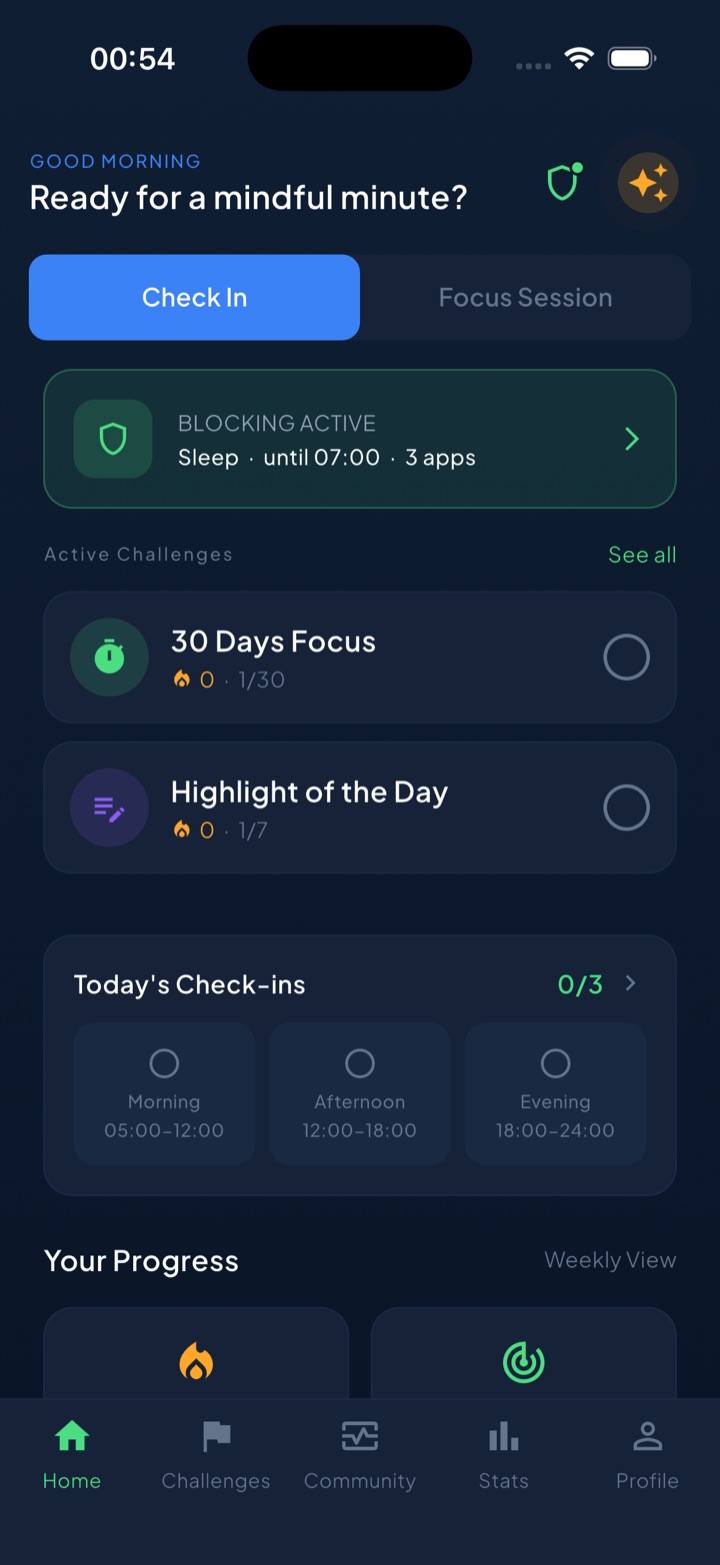
Unscrol is an iPhone and Apple Watch app built around two numbers: a daily total (45 minutes by default) and a per-session maximum (5 minutes by default), both enforced through Apple’s Screen Time and FamilyControls frameworks rather than a cosmetic overlay. Spend a session-sized chunk of the budget and the chosen apps lock for 15 minutes; spend the whole daily budget and they lock until tomorrow. Shield is the scheduled half: you pick the windows by time of day, which is where market hours and sleep hours go, and switching it off mid-block is deliberately slow — a breathing exercise and a wait, not a one-tap dismissal. A streak counts every day you stayed under budget, and home-screen and lock-screen widgets show what is left without you opening anything.
Two caveats, stated plainly. The usage numbers are estimates, because iOS reports through crossed thresholds across an interval rather than exact minutes, so treat the budget as approximately right. And iOS hands the app opaque tokens rather than app identities: Unscrol cannot see which apps you picked, their names or their icons, so it does not know you put a broker behind a shield any more than it knows you put a game there. The system draws the picker; the app draws the frame around it, and your block list and usage stay on-device. Free to download, with an optional premium tier adding Streak Saver for a missed day and five concurrent challenge slots instead of one.
The market will move whether you are watching or not. That is the one genuinely reassuring fact in this whole business, and it is the fact the app in your pocket is engineered to make you forget.
Frequently asked questions
How often should I check my portfolio?
That depends entirely on how often you actually make decisions, and for most people the honest answer is far less often than they check. If your plan is measured in years, the useful cadence is roughly weekly or monthly, because that is the frequency at which anything you would act on becomes visible. Checking every few minutes does not give you a higher-resolution picture of your investments, it gives you a higher-resolution picture of noise. The rule of thumb worth writing down is simple: decide your real decision frequency first, then let that number set your checking frequency, rather than the other way around.
Why do I feel anxious when I check my stocks?
Because losses land harder than equivalent gains, and the more often you look, the more losses you experience. A portfolio that finishes a year well is still red on a large share of individual days, so someone checking twenty times a day encounters far more red moments than someone checking once a week, even though they hold exactly the same thing. Behavioural economists call this myopic loss aversion: the frequency of your sampling, not the performance of the asset, is what generates the dread. The anxiety is a property of the checking, not of the position.
Why are crypto apps harder to put down than stock apps?
Because crypto never closes. Equity markets have an opening bell and a closing bell, which means the app eventually runs out of new things to tell you and your attention gets a natural boundary for free. A 24/7 market removes that boundary completely, so there is no moment in the day, week or year when checking is objectively pointless. It is the same structure as an infinite feed with no bottom of the page, and it produces the same behaviour: you stop when you are exhausted rather than when you are finished.
Is it a bad sign that I check my trading app at 3am?
It is a very common one, and it usually has a mechanical explanation rather than a psychological one. If you live outside the United States, the US open falls somewhere in your evening or night, and crypto simply has no schedule at all, so the market's most volatile hours line up with your sleeping hours. The problem is that a 3am check is the lowest-quality decision environment you will ever be in: you are tired, alone, and looking at the most volatile part of the session. Blocking the apps during your sleep window is the single change that removes the most bad decisions per unit of effort.