Do not try to defeat the urge. Outlast it. A craving to check behaves like a wave rather than a rising line: it builds, crests, and falls on its own if you do not feed it. So in those sixty seconds, stop moving, notice where the feeling sits in your body, and name it in one or two plain words — bored, anxious, avoiding, annoyed. Naming it is not a soothing ritual; it measurably takes the edge off. Then pick one small physical next action and let the wave finish without you.

What is urge surfing?
A technique from addiction research. The psychologist G. Alan Marlatt developed it as part of relapse prevention, and it is now standard in mindfulness-based relapse-prevention programmes. The metaphor is the whole method: an urge is a wave. It builds, peaks, breaks and recedes. Your job is not to stop the wave — you cannot — but to stay on the board while it passes.
What separates it from resisting is the target. Resisting treats the urge as an enemy, which keeps your whole attention on the thing you are trying not to do. Surfing treats it as weather to be observed. In one often-cited study, smokers given a short urge-surfing instruction smoked fewer cigarettes over the following week than a control group. That is the appeal: not a personality change, a small skill.
Why does a craving fall on its own?
Because it is a response, and responses have a shape. The pull you feel is anticipation rather than enjoyment: the dopamine system reacts to the cue and the possibility, not the payoff, and it does that in a burst rather than a plateau — the mechanism behind dopamine and social media. A cue fires, the system spikes, and if nothing arrives the spike subsides. You have felt this without noticing, every time you reached for your phone, got interrupted, and forgot you wanted it.
What keeps an urge alive is usually not the urge. It is the internal argument — just one look, only messages, I have earned this. That negotiation re-triggers the cue every few seconds, which is why gritting your teeth often produces a longer and more painful minute than doing nothing at all.
Popular versions of the idea promise a fixed duration, ninety seconds or sixty. Treat those as containers rather than measurements: the well-supported part is the shape, not the clock.
What is actually happening in those sixty seconds?
Three things, and only one of them resembles willpower.
The automatic sequence breaks. Reach, unlock, open, scroll takes under two seconds and contains no decision point. Standing still inserts one.
The feeling becomes an object. Unnamed, the urge is the water you are swimming in. Named, it is a thing in front of you with edges — and you can decline a thing with edges.
You collect evidence. Every rep teaches the same lesson: it arrived, it peaked, nothing bad happened, it left. That belief does the long-term work and can only be learned by experience.
Why does naming the feeling reduce its grip?
The effect is called affect labelling, one of the sturdier findings in emotion research: putting an internal state into words, even a single word, reliably lowers its intensity.
Neuroimaging work led by Matthew Lieberman at UCLA found that labelling an emotion was associated with reduced amygdala activity and increased activity in the right ventrolateral prefrontal cortex, a region involved in inhibiting responses. Later work by Kircanski, Lieberman and Craske compared strategies in people afraid of spiders: labelling reduced physiological arousal more than reappraisal or distraction, and those using the most emotionally specific words benefited most.
So be specific and unflattering — “a bit off” does very little, “bored and slightly humiliated by that email” does a lot — and do not attach a judgement. Labelling is I am anxious, not I am anxious and I should not be. The second is an argument, and arguments feed the wave.
What do I actually say in those sixty seconds?
Phone face down or in the pocket for the whole minute. Sub-vocal works; out loud works better.
- 0–10s. Stop and state the fact. Both feet on the floor. Say what happened, not what you want: “The block came up. I reached for it anyway.”
- 10–25s. Find it in the body. Jaw, chest, stomach, the hand already moving. Where is it, and is it hot, tight, restless, hollow?
- 25–40s. Name it in one or two words. Bored. Anxious. Lonely. Avoiding. Annoyed. Whichever word makes you wince slightly is usually the right one.
- 40–50s. Rate it and aim it. Zero to ten, then ask what it is about: the app, or the task you were about to start?
- 50–60s. Choose the next physical action. Small and specific. Stand up. Fill the glass. Open the document. Not “be better.”
That is the whole thing, and it survives a queue, a lift, a desk and a bus stop.
Why is this better than just resisting?
| Just resist | The one-minute reset |
|---|---|
| Treats the urge as an enemy | Treats the urge as weather |
| Success means not feeling it | Success means feeling it and not acting |
| Attention stays on the app | Attention moves to the body |
| Silence, then a snap decision | A script you do not have to invent while agitated |
| Each win raises the stakes for the next | Each rep lowers them |
| Nothing learned when it fails | You still learn what the urge was about |
The last row matters most. Resisting is binary — you held or you caved — and either way you learn nothing about what the moment actually was. The reset produces information even on days you unlock the phone anyway, and “lonely” is a completely different problem from “avoiding the report”.
Why am I angry at a blocker I set up myself?
Because restriction increases wanting. Psychologists call it reactance: remove a freedom and the removed option becomes more attractive while you feel a push to reassert control. Jack Brehm described it in 1966 and it has been replicated from advertising to parenting.
That is exactly the moment the shield appears. You are not, in that instant, longing for a feed. You are objecting to being told — which is why a small grey screen produces a real flash of irritation, and why debating whether the app is worth it misses the point. The wanting is about the constraint, not the content.
Reactance is also short-lived: it spikes at the boundary and drops. Sixty seconds of naming — I am annoyed at being stopped, not at missing anything — is usually enough to see it for what it is, and it is why a blocker that is slow to switch off beats one with a dismiss button. See why you keep bypassing your app blocker.
“The block came up while I was queuing for coffee and I was properly irritated, like the phone had taken something off me. I only did the sixty seconds because it was there. What came out was ‘I do not want to go back to the ward yet.’ It had nothing to do with Instagram. I have thought about that more than any chart the app has ever shown me.” — Rachel, ward nurse, 31
What if sixty seconds is not enough?
Sometimes it is not, and pretending otherwise is how people conclude the technique is fake. Three honest limits.
The urge can be a symptom. If the label that keeps returning is lonely or dread, the reset is a diagnostic rather than a treatment, pointing at something worth taking seriously somewhere other than your phone.
A gap gets refilled. Ending the minute with a physical action is the load-bearing step, not decoration. Leave a void and the old habit fills it — see things to do instead of scrolling.
Some days you will unlock the phone anyway. Do the minute regardless; the rep is the point, not the outcome. Tolerating an unfilled moment is trainable, as in why boredom is good for your brain, and every attempt counts.
How does Unscrol help?
Nothing above requires an app. The script is free, works in a supermarket queue, and improves with repetition. Apple’s Screen Time is free too — App Limits and Downtime are already on your iPhone, and if a Downtime window creates the pause where the minute happens, you are finished and should stop reading.
Unscrol is for the case where the pause never arrives because nothing interrupts you. It is an iPhone and Apple Watch app built on Apple’s Screen Time frameworks, so blocks are applied by iOS rather than drawn as an overlay. You pick two numbers: a daily total (45 minutes by default) and a per-session maximum (5 minutes by default). Spend a session-sized chunk of the budget and the chosen apps lock for 15 minutes; spend the whole daily budget and they lock until tomorrow. A streak counts every day you stay under.
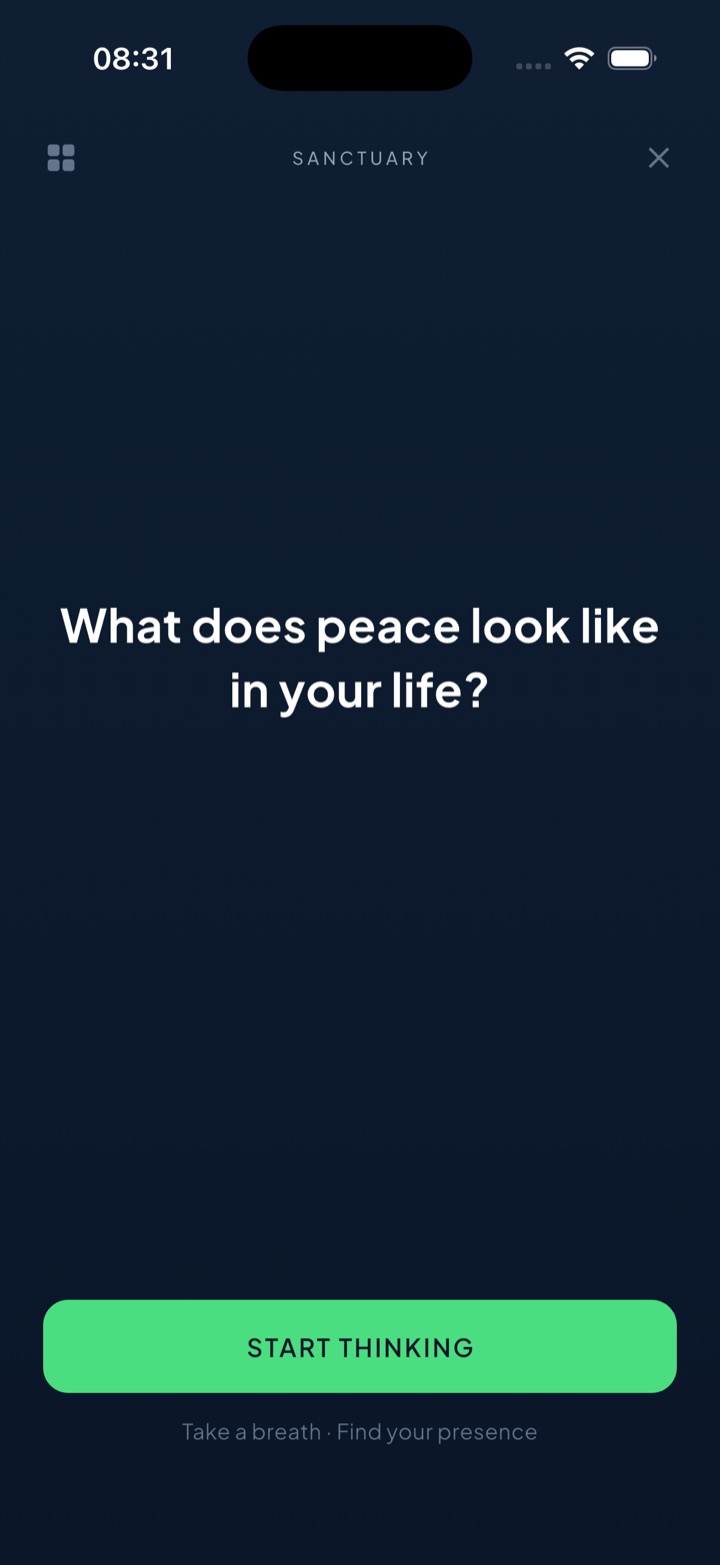
Mind Break is this article built into the app: a one-minute reflection for the moment the wall appears. Shield is blocking you can schedule by time of day, and turning it off mid-session is deliberately slow — a breathing exercise plus a wait rather than a one-tap dismiss. That slowness is the design answer to reactance: the delay outlasts the flash of irritation, which a dismiss button never does.
Around that sit roughly 117 challenges across eight categories and 28 widgets. Privacy is architectural: iOS hands over opaque tokens, so Unscrol can never see which apps you picked, their names, their icons, or your per-app usage. Free to download, tracking one challenge at a time; premium adds Streak Saver and five slots. The app is dark, calm and never tells you off. It puts a wall up, waits a minute with you, and hands the decision back.
Frequently asked questions
What is urge surfing and does it work for phone use?
Urge surfing is a technique from addiction relapse-prevention work developed by psychologist G. Alan Marlatt. Instead of fighting a craving, you observe it as a wave that rises, crests and falls on its own. You stay with the sensation, notice where it sits in your body, and let it pass without acting. It transfers well to phone checking because a checking urge is short-lived and cue-driven rather than a genuine need. In one study, smokers given brief urge-surfing instructions smoked less over the following week than a control group, and the instructions took only minutes to deliver.
What should I do in the 60 seconds after the urge to check my phone hits?
Do four things in order. First, stop moving and leave the phone face down, so the automatic sequence of hand, unlock and open is broken. Second, find the feeling physically, in the jaw, chest, stomach or the hand that was already reaching. Third, name it in one or two plain words, such as bored, anxious, lonely, avoiding or annoyed, without adding a judgement about it. Fourth, choose one small physical next action and start it: stand up, fill a glass, open the document. Sixty seconds is a container, not a cure. Doing it badly still counts.
Why does naming a feeling make it weaker?
The effect is called affect labelling and it is one of the more robust findings in emotion research. Neuroimaging work led by Matthew Lieberman at UCLA found that putting a feeling into words was associated with reduced amygdala activity and increased activity in the right ventrolateral prefrontal cortex, a region involved in inhibiting responses. Later research comparing strategies in people afraid of spiders found labelling reduced physiological arousal more than reappraisal or distraction, and that the participants using the most emotionally specific words benefited most. Be specific and unflattering, and do not attach a judgement to the label.
Why am I angry at an app blocker I set up myself?
Because restriction increases wanting. Psychologists call it reactance: when a freedom is taken away, the removed option becomes more attractive and you feel a push to reassert control. In the moment the shield appears you are usually not longing for the app itself, you are objecting to being told. That is why the irritation feels out of proportion to a grey screen, and why arguing with yourself about whether the app is worth it misses the point. Reactance spikes at the boundary and fades quickly, which is exactly what a 60-second pause is long enough to outlast.