For most people a short cooldown holds where a daily cap does not, and the reason is timing rather than toughness. A limit that locks your apps for fifteen minutes releases you shortly after the urge has already passed, because urges crest and fade in minutes rather than hours. A limit that locks them until midnight outlives the urge by ten hours, which turns a small correction into a punishment — and punished people uninstall the tool. The strongest setup uses both: a cooldown that fires often and a daily ceiling that fires rarely.
How long does an urge to open an app actually last?
This is the number the whole design rests on, and almost nobody looks it up.
Clinical work on cravings — most of it from smoking, drinking and eating rather than from phones — consistently describes an urge as an event with a shape rather than a state you are stuck in. A cue arrives, the wanting climbs, it peaks, and then, if you do nothing at all, it falls away. The technique built on that observation is urge surfing, developed by the psychologist Alan Marlatt: do not fight the wave, stay on the board until it breaks.
The timings taught vary but the range is consistent — a peak within the first few minutes, a clear decline within twenty to thirty minutes. Phone urges are, if anything, shorter.
That single fact reorganises everything. Your limit does not need to be strong. It needs to be longer than the wave. Fifteen minutes clears the crest with room to spare, and it is short enough that waiting is a genuine option rather than a theoretical one — a close relative of the point in why boredom is good for your brain.
Why do all-or-nothing lockouts get switched off?
Because the maths does not work in their favour.
Consider the decision at the moment one fires. It is 09:15 on a Tuesday, your budget is gone, and the system proposes fifteen more hours without your chosen apps — a workday, an evening and a bus ride. The tool offering this deal costs one long-press and a tap to delete.
Nobody accepts that trade, and the failure is not moral. The punishment is out of proportion to the offence, which is the definition of a rule people stop respecting. Three things go wrong at once:
- Disproportion. A few minutes of drift costs the rest of the day.
- Collateral damage. Long blocks eventually catch something real — a boarding pass, a two-factor code, a message that mattered. One collision reframes the tool as an obstacle.
- The escape hatch is bigger than the block. You own the phone, so the way out of a day-long lockout is not a clever bypass; it is deleting the blocker. That is exactly what people do, as covered in why you keep bypassing your app blocker.
The single most important property of any behaviour tool is that it is still installed in week six. A daily cap trades that away for a feeling of seriousness on day one.
What is the “what the hell effect” and why does it wreck daily caps?
Janet Polivy and Peter Herman ran a series of studies on restrained eaters: participants drank a milkshake first, then ate freely. The dieters who believed they had already blown their limit did not eat a little more than the others. They ate substantially more — often more than the people not dieting at all.
Polivy named it the what-the-hell effect. Relapse researchers, working separately, described the same collapse and called it the abstinence violation effect. Both say one thing: when a rule is binary, breaking it removes the reason to hold any line for the rest of the period.
A daily cap is a binary rule with a twenty-four-hour period — close to the worst possible configuration. Spend the budget at 09:15 and the day is already a write-off in your own accounting, so the next eight hours are free. On the days it fires, the limit does not merely fail; it produces the binge it was meant to prevent.
A cooldown has no such property, because the unit it protects is fifteen minutes rather than a day. There is always something left to protect, and never a point at which nothing further matters. That is the same logic behind the never-miss-twice rule and what actually happens when you lose a streak.
What does a cooldown change, exactly?
| Day-long lockout | 15-minute cooldown | |
|---|---|---|
| When it releases you | Ten hours after the urge died | Shortly after the urge died |
| Proportionality | A few minutes of drift costs a day | A few minutes of drift costs a quarter of an hour |
| What you do with the wait | Nothing — you go around it or quit | You wait it out, which is a real option |
| What a slip costs | The rest of today | The next fifteen minutes |
| Typical failure mode | Delete the blocker | Occasionally resent it |
| What it teaches you | The tool is an adversary | The urge passes on its own |
The bottom row compounds. A day-long lockout cannot teach you that urges fade, because you leave the room and never see the ending. A cooldown makes you sit through it: every wait is one repetition of I wanted it, I waited, I stopped wanting it, and after a few dozen repetitions that stops being a technique and becomes something you believe.
Doesn’t Apple already offer a 15-minute option?
Sort of, and the difference is instructive. When you hit an App Limit, iOS offers Remind Me in 15 Minutes. Same number, opposite direction: choosing it does not close the app or lock anything, it leaves you exactly where you are, still scrolling, and re-raises the alert a quarter of an hour later. The other option, Ignore Limit, hands you the rest of the day in one tap.
Apple’s fifteen minutes is a snooze on a reminder. A cooldown is the inverse — the app closes and cannot reopen for fifteen minutes. One postpones the interruption, the other enforces it, which is the whole gap described in why screen time limits don’t work.
Should there be no hard daily limit at all, then?
No — remove the ceiling and a bad evening runs forever. Cooldowns alone are just a metronome for a four-hour session. The design that holds is two layers with different jobs: a per-session maximum that fires several times a day, costs almost nothing each time and does the bulk of the work, plus a daily total that fires rarely and ends the day properly.
The ceiling stops feeling like an ambush because by the time you reach it you have sat through several cooldowns and watched the budget go. The ending arrives as a conclusion rather than a surprise, and a limit you saw coming is one you argue with far less.
“I had a one-hour daily limit for about three weeks. Every time I hit it before lunch I’d turn the whole thing off, because what was I supposed to do, not have my phone until midnight? The version that stuck locks me out for fifteen minutes at a time. It’s annoying roughly four times a day and I have never once been annoyed enough to delete it.” — Daniel, ward nurse, 34
How do you set a cooldown you will actually keep?
- Set the session length to a real reason. Most legitimate opens take a few minutes: reply, check, close. Set the per-session maximum near that, not near what you wish you needed.
- Set the cooldown longer than the urge and shorter than your patience. Fifteen minutes suits most people. Five is too short to clear the crest; an hour starts to feel like punishment.
- Keep a daily ceiling, but pick an honest one. A fantasy number gets hit at 10am and drags the what-the-hell effect straight back in.
- Decide it in a calm hour. Sunday morning, not Tuesday midnight — the core of commitment-device psychology.
- Do not put logistics in the same bucket as entertainment. If the app holding your work messages is locked, you will disable everything to reach it.
- Put something in the fifteen minutes. A gap you do not fill gets filled for you — see things to do instead of scrolling.
How does Unscrol help?
Honest part first: Apple’s Screen Time is free and may be all you need. App Limits, Downtime and a passcode someone else holds are a real system, and if you respect the limit screen when it appears there is nothing here worth paying for. Set that up before installing anything.
Unscrol is an iPhone and Apple Watch app for the case where that limit screen stopped meaning anything. It is built on the same Apple Screen Time frameworks, so the locks are enforced by iOS rather than drawn as an overlay you can swipe past.
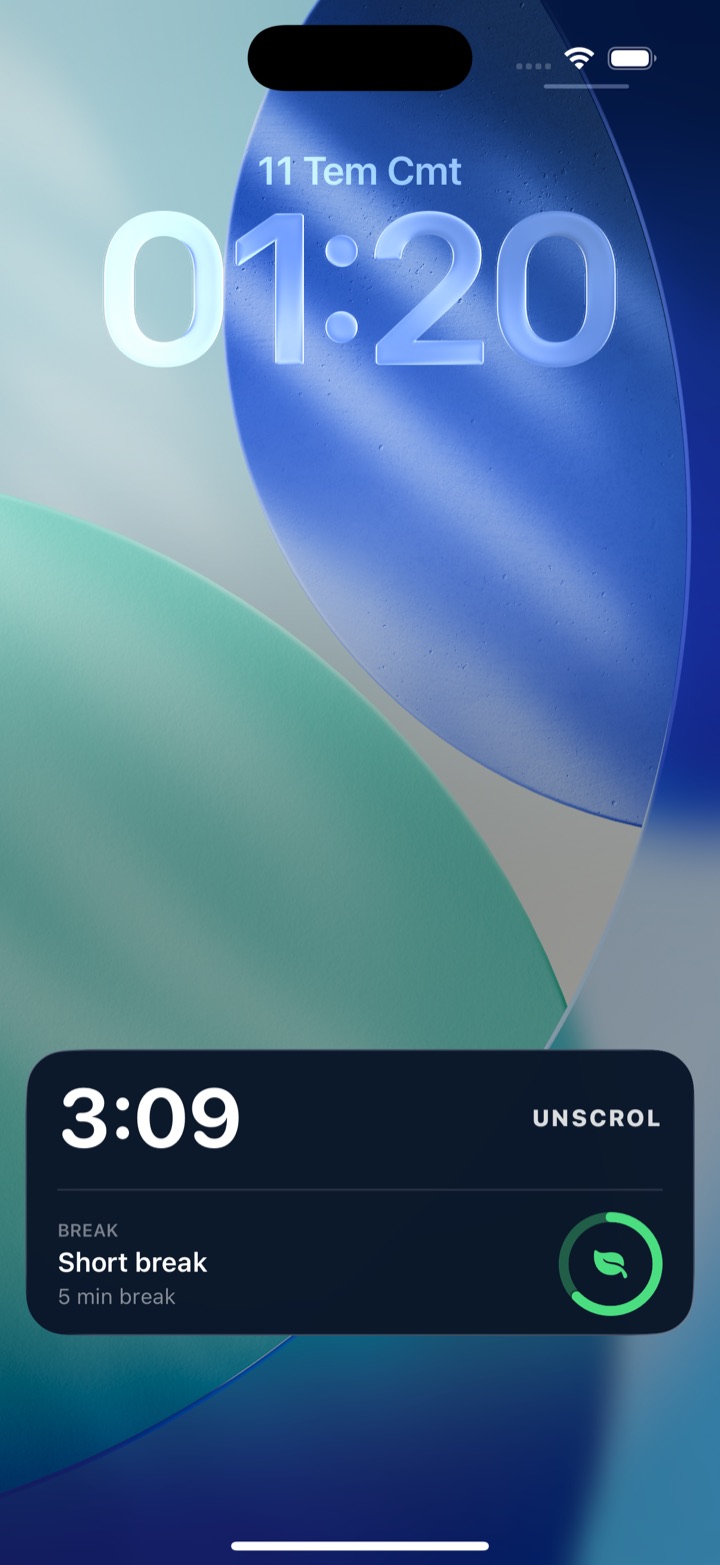
It is the two-layer design above, expressed as two numbers you pick: a daily total (45 minutes by default) and a per-session maximum (5 minutes by default). Use a session-sized block of your budget and your chosen apps lock for 15 minutes. Spend the whole daily budget and they lock until tomorrow. A streak counts every day you finish under budget, so staying inside the system is something you build rather than a test you keep failing. A schedulable Shield covers windows such as sleep or work, and turning it off mid-session is deliberately slow — a breathing exercise and a wait, not a one-tap dismiss.
Two caveats, plainly. The numbers are estimates derived from thresholds iOS reports as they are crossed, not from a stopwatch, so read them as a block of your budget rather than a precise minute count. And the privacy model is architectural rather than promised: iOS hands the app opaque tokens, never app identities, so Unscrol cannot see which apps you picked, their names or their icons, and block lists never reach its servers. Free to download; the optional premium tier adds Streak Saver for a missed day and five concurrent challenge slots instead of one.
Frequently asked questions
How long does the urge to open an app actually last?
Far less time than most people assume. Craving research and clinical relapse-prevention work both describe an urge as a wave rather than a state: it builds after a cue, crests, and subsides on its own without any action from you. Clinicians teaching urge surfing usually tell people to expect a peak inside the first few minutes and a noticeable drop within roughly twenty to thirty minutes. Individual urges vary and the research was not done on Instagram, but the shape holds. The practical implication is that a limit only has to outlast a wave, not a day.
Why do people turn off app blockers that lock them out for the whole day?
Because the punishment is out of proportion to the mistake, and because you own the device. If spending your budget at 09:15 means no messaging, no maps and no music until midnight, the rational move at 09:16 is to disable the blocker entirely. That is not weak willpower, it is arithmetic. Long lockouts also collide with genuine needs such as a boarding pass or a two-factor code, and every collision converts the tool from a helper into a warden. A limit that cannot survive one bad morning will not survive six weeks.
What is the 'what the hell effect'?
It is a well-documented pattern from dieting research by Janet Polivy and Peter Herman: people who believe they have already broken a rule go on to break it far more than people who believe they are still inside it. The rule is binary, so once it is violated there is nothing left to protect and restraint collapses. Relapse-prevention researchers describe the same thing as the abstinence violation effect. Any daily cap invites it, because once the day is spent, the day is a write-off and every further hour is free.
Is it better to set a per-session limit or a daily limit on apps?
Use both, with different jobs. A per-session maximum with a short cooldown is the rung that fires many times a day, and it works because it ends shortly after the urge does rather than hours later. A daily total is the ceiling that fires rarely and ends the day properly. On their own, a session limit alone lets a determined evening run indefinitely, and a daily cap alone produces one dramatic all-or-nothing collapse. Layered, the small limit does the everyday work and the big one is the backstop.