There is no right age, and chasing one is why this decision feels impossible. Every parent googling this wants a number they can say out loud in the class group chat and have it hold. The honest answer is that no such number exists, because a smartphone is not one thing. It is a bundle of four separate capabilities that arrived together for historical reasons, and you are allowed to unbundle them. Once you do, the question stops being when and becomes which, in what order — and that is a question you can actually answer.

So is there a right age for a first phone?
Not one that survives contact with a real child. The research that exists tells you about populations, not about your kid, and it mostly says what you would expect: earlier and heavier use of social feeds correlates with worse outcomes, especially for girls, especially around puberty. It does not produce a threshold you can put in a calendar.
What has changed in the last few years is that a set of shared norms has finally emerged, which is genuinely useful. The smartphone-free-childhood movement — parent pledges like Wait Until 8th, and the norms popularised by The Anxious Generation — converged on roughly this: no smartphone before high school, around fourteen, and no social media before sixteen. Meanwhile the actual average age of a first phone has drifted down to somewhere around ten or eleven in most surveyed countries.
Hold those two facts next to each other and you can see the real dynamic. The gap between the recommended age and the actual age is not a gap in parental knowledge. It is a coordination failure. Parents are not handing over phones because they think eleven is ideal. They are handing them over because their child is the last one.
That is the problem worth solving, and it is not solved by picking a better number.
Why is a smartphone four decisions instead of one?
Because “getting a phone” quietly grants four unrelated things at once: the ability to be reached, the ability to reach the whole internet, the ability to be reached by anyone, and an algorithmic feed. Those have wildly different risk profiles, and nothing forces you to grant them on the same day.
| Rung | What it unlocks | What it still keeps out | Where parents commonly land |
|---|---|---|---|
| 1. Reachability | Calls and texts with a short approved list; you know they got there | Browser, app store, group chats, feeds | 8–10 |
| 2. Shared family device | Video calls, homework, a supervised toe in the water, in a shared room | Anything private, anything in a bedroom, anything portable | 9–11 |
| 3. Smartphone, no feeds | Maps, music, camera, messaging with friends, a real pocket computer | TikTok, Instagram, YouTube autoplay, infinite scroll | 12–14 |
| 4. Feeds | The thing everyone is actually arguing about | — | 15–16 |
The row that matters most is the third. A smartphone without social feeds is a genuinely good product for a twelve-year-old — it does maps and music and messaging and photos, and it does not contain a machine engineered to hold attention. Most of what your child is asking for lives on rung three. Most of what you are afraid of lives on rung four. Separating them turns one enormous argument into a much smaller one, and it gives you something to say that is not simply no.
It also gives your child a visible path. “Not yet” lands very differently when it comes with a ladder attached and a rung they can see themselves standing on.
How do I win the ‘everyone in my class has one’ argument?
You mostly do not win it. You change it from a rule into a norm, and the difference is everything.
Start with the claim itself, because “everyone” is a rhetorical device. Ask which specific children, by name. The answer is usually four, and two of those turn out to have a sibling’s hand-me-down that only works on the home wifi. That is worth knowing, though it will not end the conversation.
The real move is arithmetic. A rule made by one family is a tax your child pays alone. A norm held by five families is just how things are. This is the entire insight behind the parent-pact movement, and it works because the thing your child is genuinely afraid of is not missing the internet. It is being the odd one out of a group chat.
In practice this is less daunting than it sounds:
- You need the friendship circle, not the year group. Five or six families whose children actually spend time with yours is enough to flip the default.
- Ask for something specific. “Shall we all hold off until Year 9?” gets replies. A message about dopamine and adolescent brain development gets read and ignored.
- Go first and be relaxed about it. Most parents in that chat are quietly hoping someone else raises it, because nobody wants to be the strict one alone.
- Agree on the rung, not just the date. “Phones are fine, feeds are not until fifteen” is a pact more families will sign than a total ban.
If the pact fails and your child is genuinely isolated, that is real and you should take it seriously rather than dismiss it. But solve it on rung one or two — reachability and a family device cover almost all of the social exclusion at that age.
“I spent two years dreading this conversation and about forty minutes actually having it, once I stopped defending a rule and just asked four other mums in the football WhatsApp group whether they fancied waiting together. Three said yes immediately. One said she had been about to ask us. My son still thinks we are unreasonable, but he thinks we are unreasonable along with his friends, which is an entirely different feeling for him.” — Rachel, secondary school teacher, 41
What readiness signals matter more than a birthday?
These are dials, not a pass mark. No child scores well on all of them, and waiting for a perfect score means waiting forever.
Do they tell you when something goes wrong? This is the single best predictor, and it outranks everything else on the list. A child who reports the weird message, the mean group chat, the thing they saw and did not understand is a child who is safe on a phone far earlier than one who hides trouble. If your child currently hides bad marks and broken things, a phone will be hidden too.
Can they stop something they enjoy, once, without a scene? Not cheerfully. Once, when asked. If Minecraft on the family iPad already produces a nightly negotiation, adding a device that lives in their pocket will not improve it.
Do they keep track of physical objects? Unglamorous but real. Water bottles, keys, coats.
Can they read intent in a message? Text strips tone. A child who reads a blunt reply as an attack will have a harder time than one who asks what someone meant.
Do they have a life to come back to? A phone fills whatever space is already empty. Sport, instrument, friends who exist in three dimensions, a boring Sunday afternoon they know how to survive — these are the real protective factor, and they matter more than any setting. Our screen time recommendations by age covers what the balance tends to look like at each stage.
What goes in the contract, and when?
Day one. This is the part almost everyone gets wrong, and it is not close: retrofitting rules onto a phone your child already owns is about ten times harder than starting with them. Rules present at handover are simply the terms of the device. Rules added in month four are a punishment, and they will be experienced as a betrayal, because from your child’s point of view they are.
Three rules carry most of the weight.
The phone charges outside the bedroom overnight. If you set only one, set this one. It protects sleep, which protects mood, school and impulse control. It also happens to be the rule that is impossible to introduce later without a fight, so it has to be there from the beginning. Buy a cheap alarm clock the same day you buy the phone and the objection disappears before it is raised.
You know the passcode, with a stated policy. Not surveillance theatre. Say plainly when you would look and when you would not, and stick to it. Trust that is defined is easier to keep than trust that is assumed.
New apps get a conversation, not a download. Apple’s Family Sharing handles the mechanics — Ask to Buy, App Limits, Downtime, content restrictions, all free and all reasonably good. Our parental controls guide for iPhone walks through the setup. The conversation is the point, though; the toggle is just what makes the conversation happen.
Add one more thing: a review date. Every six months, in writing. Restrictions your child can see themselves growing out of are negotiable. Restrictions with no end date get circumvented, and a teenager who has decided to route around you is a much harder problem than a twelve-year-old with a bedtime rule. If you are already there, when your teenager will not get off their phone is written for that stage.
Does my own phone use change how this goes?
Yes, and this is the uncomfortable part of the article.
Children do not learn phone habits from the rules they are given. They learn them from the behaviour they watch for a decade before they are given anything. The eight-year-old currently lobbying you for a phone has already absorbed a working model of what a phone is for, and they built it by watching an adult reach for one in every pause: in queues, at traffic lights, mid-sentence, during their story about school.
This shows up in two ways. The obvious one is legitimacy — a no-phones-at-dinner rule dies the first time it is broken by the person who wrote it, and children track that with forensic accuracy. The less obvious one is that the habit of using a screen to end an uncomfortable feeling gets taught long before anyone owns a device; it is the same mechanism as using screens to calm toddlers, just aged up.
The fix is not guilt, it is a visible edit. Pick one specific window — the school run, dinner, the first hour after they get home — and be genuinely unreachable in it. A phone-free family dinner is the usual place to start, and distracted parenting covers what the smaller everyday version of this costs. Your child does not need you to be perfect. They need to have seen it done.
How does Unscrol help?
Start with what you already own, because a lot of this is free. Apple’s Screen Time with Family Sharing gives you parental controls on your child’s device: per-app and per-category App Limits, Downtime for scheduled windows, content and privacy restrictions, and Ask to Buy so new apps need your approval. For a first phone on rung three, that plus the charging rule covers most of what matters, and you should not buy anything until you have actually set it up. Where it runs out is the shape of the limit: App Limits are cumulative daily budgets, there is no per-sitting cap, and the limit screen ships with a one-tap dismissal.
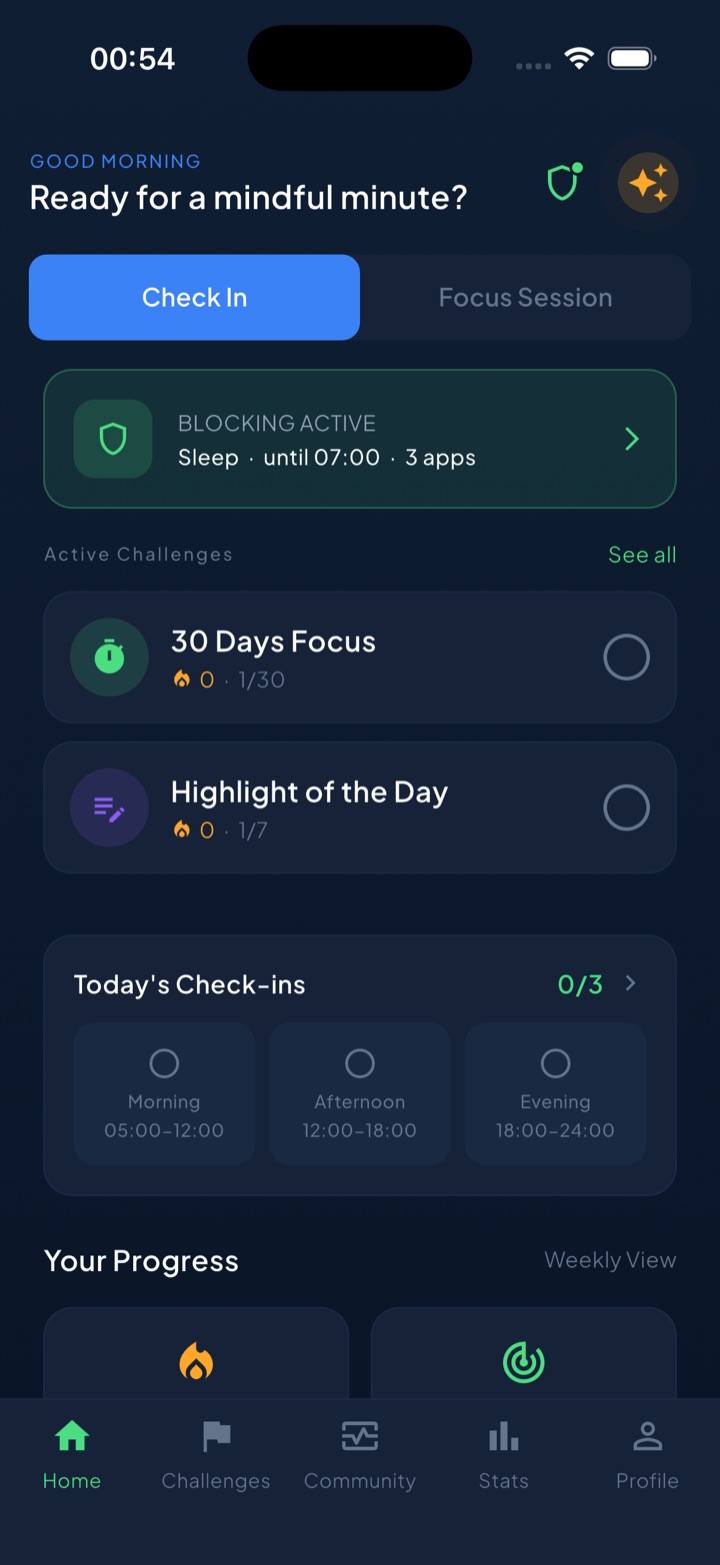
Unscrol is an iPhone and Apple Watch app that adds the missing shape, and it is worth saying there are two different jobs here. On a child’s first phone it supplies structure: a daily total (45 minutes by default) and a per-session maximum (5 minutes by default), enforced by iOS through the Screen Time and FamilyControls frameworks. Spend a session-sized chunk of the budget and the chosen apps lock for 15 minutes; spend the whole daily budget and they lock until tomorrow. Shield is scheduled blocking by time of day — homework, dinner, after nine — and switching it off mid-block is deliberately slow, a breathing exercise and a wait rather than a one-tap dismissal. A streak counts every day under budget, and home-screen and lock-screen widgets show what is left without opening anything.
The second job is the mirror. Most parents reading this have a phone problem of their own that predates their child’s, and the same daily total and evening Shield window work exactly as well on an adult who wants the school run back.
Two honest caveats. The usage numbers are estimates, because iOS reports through crossed thresholds across an interval rather than exact minutes, so treat the budget as approximately right rather than precise. And iOS hands the app opaque tokens, never app identities: Unscrol cannot see which apps were picked, their names or their icons. The system draws the picker; the app only draws the frame around it, and block lists and usage data are processed on-device by iOS and never reach Unscrol’s servers. Free to download, with an optional premium tier adding Streak Saver for a missed day and five concurrent challenge slots instead of one.
Frequently asked questions
What age should a child get their first smartphone?
There is no evidence-based age that works for every child, which is why no serious source gives one. The norms currently gaining ground among parents are a smartphone at around fourteen and social media at around sixteen, and they are useful precisely because they are shared rather than because they are proven. The more practical answer is that age is the wrong unit. A ten-year-old with a call-and-text phone and no browser is in a completely different situation from a fourteen-year-old handed an unrestricted device, so what matters is which capabilities arrive when, not which birthday has passed.
Should my 10-year-old have a phone?
Most ten-year-olds who get a device do not actually need a smartphone, they need to be reachable. Those are different problems with different solutions, and conflating them is how families end up handing over a full internet terminal to solve a lift-home logistics issue. A watch or a basic phone that does calls and texts solves reachability completely and costs you nothing on the attention side. If your ten-year-old genuinely needs more than that, it is worth writing down exactly what for, because that sentence usually turns out to describe one app rather than a whole phone.
Do parent pacts like Wait Until 8th actually work?
They work far better than a rule one family makes alone, because they change what counts as normal rather than what counts as allowed. A child who is the only one without a phone is paying a real social cost, and no amount of explaining will make that cost go away. A child who is one of six without a phone is simply in a group, and the pressure largely evaporates. You do not need the whole year group either, five or six families in your child's actual friendship circle is usually enough to change the maths entirely.
What rules should I set on a child's first phone?
Set them on day one, because retrofitting rules onto a phone a child already owns is roughly ten times harder than starting with them. Three carry most of the weight: the phone charges outside the bedroom overnight, you know the passcode with a stated policy about when you would use it, and new apps get a conversation rather than a download. Give the rules a written review date, perhaps every six months, so your child can see that the restrictions are a starting point they can earn their way out of rather than a permanent verdict on their character.