Touch grass means log off, go outside, and put your hands on something physically real, because your sense of proportion has drifted. It is the internet’s shorthand for a specific condition: you have been online long enough that the stakes of a thread now feel like the stakes of your life. It is used as an insult, it is usually deserved, and that is not the uncomfortable part. The uncomfortable part is that when researchers went looking, the joke turned out to be literally correct.

What does touch grass actually mean?
Literally: go outside and touch some grass. Figuratively: you have lost proportion, and you need contact with physical reality to get it back.
The phrase works because grass is the least impressive thing imaginable. It is not go on a retreat or reconnect with nature. It is the most ordinary object available, growing in every park and on every verge, requiring no plan, no gear and no personality change. The insult is precise. Your problem is not that you need a life-changing experience. Your problem is that you have not been outside.
It gets deployed as a reply, at the exact moment someone posts something that reveals scale drift: four paragraphs about a stranger’s opinion, a grudge against a person who does not know they exist, a take buried so deep in the discourse that nobody outside the thread could follow it. Touch grass is a diagnosis delivered rudely, and it names something real.
It runs with a small family of relatives. Terminally online describes someone whose entire frame of reference is the internet. Chronically online is the slightly gentler version, usually aimed at someone applying internet-discourse rules to an ordinary situation. Log off is the imperative. They all point at the same drift.
Why does the insult land so hard?
Because everybody has been the person it describes, and knows it.
Here is the state the meme names. It is 1am. You have been reading an argument between two people you will never meet, about a subject you did not care about on Tuesday. You have refreshed the replies to your own post more times than you can count. You have written and deleted a response three times. Somewhere in there it stopped being entertainment and became a situation you are in.
That is scale drift, and it happens because a feed has no proportion built into it. A war, a celebrity divorce, a stranger being wrong about coffee and an advert all arrive at the same size, in the same rectangle, cleared with the same swipe. Your nervous system does not have a separate setting for this is a global catastrophe and this is a person being annoying on the internet. It has one setting: something is happening. Six hours of that and your read on what actually matters this week is genuinely gone.
The meme works because it names that state in two words. People laugh at it because being seen accurately is funny, right up until you are alone.
Is there actually any science behind touching grass?
This is the part the meme did not know it got right.
Attention restoration theory is the cleanest link. Its claim is that we run on a limited pool of directed attention, the effortful kind you use to focus on one thing while suppressing everything else, and that this pool depletes. Natural environments refill it, because they hold your attention without demanding it. Leaves moving, water, clouds, a bird: interesting enough to engage you, undemanding enough to ask nothing. Psychologists call it soft fascination. A feed is the precise opposite. It draws on directed attention continuously and never lets it refill. In a well-known University of Michigan study, people who walked through an arboretum improved on a demanding attention task afterwards, while people who walked the same distance through busy city streets did not.
Rumination is the other half, and it is the one that matters at 1am. A Stanford study had participants walk for ninety minutes either in a natural setting or alongside a busy road. The nature group came back reporting less rumination, that loop of repetitive self-focused thought, and showed reduced activity in a brain region associated with it. The road group did not change. Rumination is the mechanism behind rehearsing an argument in the shower, and going outside interrupts it in a way that lying on your bed thinking about it does not.
The dose is small. One study of what its authors actually called a nature pill found that around twenty minutes spent somewhere that made people feel in contact with nature was enough to produce a measurable drop in stress hormones. Other work points at roughly two hours a week in total, split across as many visits as you like, as the threshold where people report noticeably better wellbeing. Twenty minutes, and it does not have to be a forest.
So the meme is doing something genuinely strange. It is accurate health advice, delivered as an insult, by people who were not trying to help.
How do I touch grass without turning it into a wellness project?
Do not make it a project. The moment it becomes a routine with a name, it joins the pile of things you feel bad about not doing.
The walk. Twenty minutes, no destination, phone in a pocket you have to reach into. If leaving it at home is a step too far, walking without your phone covers the version where you take it and still get most of the benefit.
The bench. If the walk is too much, sit outside for ten minutes and do nothing. Doing nothing is the active ingredient, and the first four minutes will feel unbearable. That is withdrawal, not a verdict. Why boredom is good for your brain explains what those four minutes are for.
No headphones is optional hard mode. A podcast is still input. Going out with audio still restores something, because your eyes are getting the nature part, but if you want the full version, go silent once a week and see what your head does with the space.
Actually touch it. This is not a joke about the joke. Sitting on the ground with your hands in the grass is a different experience from looking at grass through a window, and the difference is your body being involved.
The other move is having a reason to be out there, since go outside with nothing attached usually loses to the feed. That is what a dopamine menu is for, and things to do instead of scrolling is the list version. If you want the stronger dose of the same lever, exercise beats scrolling on almost every measure people actually care about.
How do I know when I need grass?
You will not notice from the inside, because scale drift is invisible while it is happening. Use tells instead.
| Tell | What it actually means |
|---|---|
| You post angrier than you talk | Your baseline moved and you cannot feel it |
| You refresh the replies to your own post | You are waiting on it the way you wait on news |
| You argue with strangers in your head in the shower | Rumination has taken the wheel |
| A thread feels like an emergency | The feed’s stakes have replaced your own |
| You cannot account for the last hour | Depth was the problem, not volume |
| Real conversations feel slow | You are calibrated to a machine’s pace |
Two or more of those in a week is not a moral failure, it is a battery reading. How to stop doomscrolling handles the feed side of it. The grass handles the rest.
“Someone told me to touch grass under a post I was genuinely proud of and I was furious for two days. Then I counted it up: nine hours that week arguing about a game patch. I started walking to the park after work with my phone on silent at the bottom of my bag. I am still online, I still post. But I have not once in four months been angry at 2am about something that did not exist on Monday.” — Marcus, backend developer, 29
How does Unscrol help?
The honest starting point: most of this needs no app at all. Grass is free, and Apple’s Screen Time already gives you daily App Limits per app or category, Downtime for scheduled windows, and a real weekly average to look at. If a daily number and a sleep schedule are enough to get you out of the door, you do not need anything else and should not buy anything. Where the built-in tools run out is the moment that matters here: iOS has no per-session cap, and its limits ship with a one-tap dismissal, so nothing ever actually ends the session you are currently in. And the session is the problem. Nobody plans the third hour.
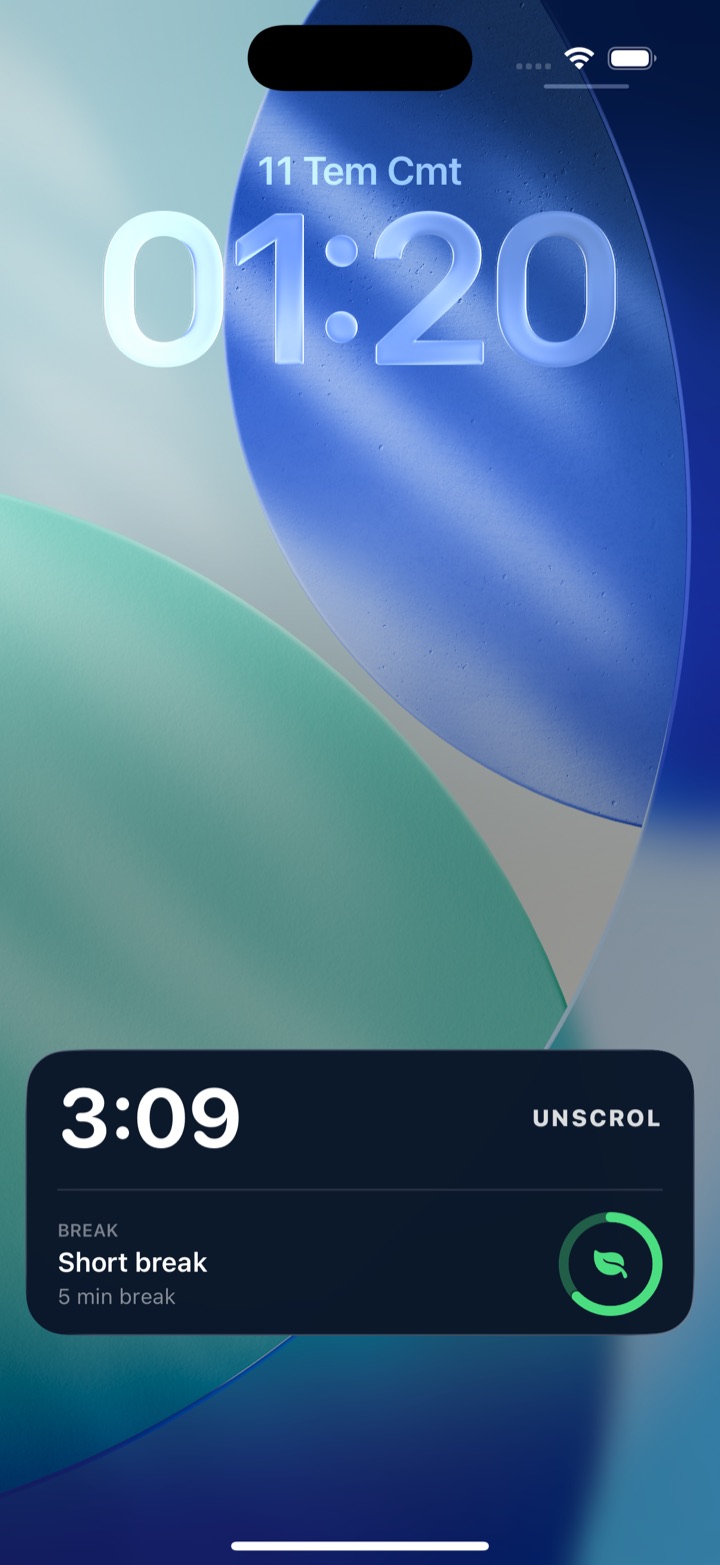
Unscrol is an iPhone and Apple Watch app built around two numbers, and the second one is the grass window. You set a daily total (45 minutes by default) and a per-session maximum (5 minutes by default), and iOS enforces both through the Screen Time and FamilyControls frameworks rather than a cosmetic overlay. Use a session-sized chunk of your budget and the chosen apps lock for 15 minutes; spend the whole daily budget and they lock until tomorrow. That 15-minute lock is the useful part here, because it is roughly long enough to get down the stairs and around the block, and it arrives without you having to decide anything. Shield handles placement: blocking you schedule by time of day, where switching it off mid-block is deliberately slow, with a breathing exercise and a wait rather than a one-tap dismissal. A streak counts every day you finish under budget, which quietly turns logging off into the thing you are protecting, and home-screen and lock-screen widgets show what is left without you opening anything.
Two caveats, plainly. The numbers are estimates, because iOS reports usage through crossed thresholds across an interval rather than exact minutes, so treat the budget as approximately right rather than precise to the second. And iOS hands the app opaque tokens, never app identities: Unscrol cannot see which apps you picked, their names, their icons or your per-app usage. The system draws the picker; the app only draws the frame around it, and block lists and usage data are processed on-device by iOS and never reach Unscrol’s servers. Free to download, with an optional premium tier adding Streak Saver for a missed day and five concurrent challenge slots instead of one.
Frequently asked questions
What does touch grass mean?
Literally it means go outside and put your hands on some grass. Figuratively it means you have been online long enough to lose your sense of proportion, and you need contact with physical reality to get it back. It is almost always used as a reply to someone whose post reveals that a piece of internet discourse has started to feel like a real emergency in their life. The phrase is rude on purpose, but it is describing a genuine state rather than just insulting someone.
Is touch grass an insult or actual advice?
Both, which is why it spread so far. It is delivered as an insult and lands as one, because nobody enjoys being told their sense of scale has drifted. But the underlying instruction is sound and is supported by a reasonable amount of research on green space, attention and rumination. The joke is that a phrase invented to be dismissive turned out to be one of the more evidence-backed pieces of advice on the internet.
Where did the phrase touch grass come from?
Meme origins are always fuzzy and this one has no single author. The phrase circulated on Twitter through the mid-2010s as a sharper version of older put-downs like go outside, log off and get a life, and it took hold first in gaming communities and on Black Twitter before spreading everywhere around 2020 and 2021. Those were the years most people were indoors on their phones, which is probably not a coincidence. What made it outlast the older versions is that it names a physical action rather than a location.
How long do I have to be outside for it to actually work?
Less than you think. Research on short nature exposure suggests that roughly twenty minutes in a place that makes you feel in contact with nature is enough to produce a measurable drop in stress hormones, and other work points at around two hours a week in total, split however you like. It does not need to be a forest or a hike. A park, a verge, a garden or a tree-lined street all count, and the study designs deliberately used ordinary urban green space rather than wilderness.