The evidence says bans work, but for a narrower set of things than either side of the argument claims. Strict school-day bans reliably change the texture of a school: quieter lessons, louder canteens, students actually talking to each other at break. The academic gains are real but modest, and they land almost entirely on the students who were struggling most. What no ban touches is the four hours after the final bell, where the large majority of a teenager’s screen time actually lives. Support the ban. Do not expect it to do your job.

Which countries have banned phones in schools?
At this point the list is shorter the other way round. France banned phones in its middle schools in 2018 and has since pushed further, requiring students to hand devices over at the door. The Netherlands issued national guidance for secondary and then primary schools. Italy barred smartphones from classrooms and extended the rule up through the senior years. Brazil passed a nationwide law. China has restricted phones in schools since 2021, England issued guidance to head teachers, and in the United States more than half the states now have some form of restriction, with New York and Florida among those requiring phones away for the entire school day.
The speed is the striking part. Almost nothing in education policy moves this fast across this many countries at once, and a small industry has grown around it: magnet-locking pouches that a student seals at the door and opens on the way out, sold to schools by the thousand.
Underneath the headlines there are really only two policies, and they are not the same intervention:
- Off and away in lessons. The phone stays with the student, silenced, in a bag or pocket.
- Away for the day, or bell to bell. The phone goes into a locker, a box or a pouch at the start of the day and comes back at the end.
Nearly every argument about whether bans work is really an argument about which of these two you mean.
Do school phone bans actually improve grades?
The study everyone quotes looked at English secondary schools that introduced bans and found test scores rose by roughly six percent of a standard deviation, comparable to adding about an hour of schooling a week. That sounds small until you look at the distribution: the gain for the lowest-achieving students was around twice the average, and for the highest achievers it was statistically indistinguishable from nothing.
That is the finding worth carrying around. A phone ban is not a performance upgrade for everyone. It is a floor under the students who were losing the most. If your child is organised, motivated and already does their homework, a ban will probably not change their report card. It was never aimed at them.
Norwegian research on middle schools found something adjacent: after bans, girls showed measurable improvements in mental health indicators, fewer doctor visits for psychological symptoms, less reported bullying, better grades and a higher likelihood of going on to an academic track, with the largest effects among girls from lower-income households. The pattern repeats across the literature. The children with the least support outside school gain the most from structure inside it, which screens and academic performance covers in more detail.
Now the honest counterweight. A 2025 study across a set of English secondary schools compared restrictive and permissive policies and found no meaningful difference in wellbeing, sleep or attainment, while also finding that overall daily phone use predicted worse outcomes. The two results are not in conflict. The restrictive schools had barely reduced total daily use, because the school day was never where most of it happened.
Why does a phone in a bag still cost something?
Because “not using it” and “not being affected by it” are different states.
In a well-known experiment, participants completed working memory and reasoning tasks with their phone face-down on the desk, in a bag, or in another room. Performance was best when the phone was in another room, worst when it was on the desk, and in between when it was in a bag. Switching the phone off did not help. And when researchers asked whether the phone had affected them, participants said no.
That last part is the whole story. A student sitting an exam with a silenced phone in their rucksack is spending a slice of attention on not checking it, and cannot feel themselves doing it. The phone-in-the-room brain drain effect is the strongest argument for the stricter version of a ban, and it is an argument about physics rather than discipline. If the device is in the room, some of the room’s attention is on the device.
Do the pouches work, or is it just theatre?
| Policy | What it actually removes | Where it leaks |
|---|---|---|
| Off and away in lessons | Visible use during teaching | Phone is still in the room; breaks become scroll time |
| Bell to bell, phone stays in the bag | Lesson use plus most social use | Bathrooms, corridors, self-enforcement |
| Locker or locked pouch at the door | The device itself | Cost, second phones, parent anxiety about emergencies |
The variable that decides whether a ban survives its first term is not the wording of the rule. It is who has to enforce it. A policy that requires a teacher to notice a phone, ask for it, and be refused generates thirty small confrontations a day and quietly decays by half term. A pouch or a locker moves enforcement to one moment at the door, performed by the same routine every morning, and takes the teacher out of the role of police officer entirely. That is the unglamorous reason pouches keep winning: not because sealing a phone is magic, but because it converts a hundred daily judgement calls into one.
“I taught through the before and the after. The before was not students texting in my lessons, honestly, most of them did not. It was the flatness. Nobody would answer a question in front of the class because the class was somewhere else. Six weeks after we went pouch-only the corridors got loud again, and I mean that as the highest compliment I can pay a policy.” — Daniel, secondary school teacher, 44
What can a school ban never fix?
The arithmetic. A teenager is on social apps something like four to five hours a day, and a school day, even a perfectly enforced one, removes maybe an hour and a half of that. Everything else happens in the kitchen, the bedroom, and the two hours that were supposed to be homework.
There is even a small backfire to watch for: some students leave a phone-free day with a pressure that discharges the moment they are through the gate, which is why 3:30pm can look worse after a ban rather than better. That is not an argument against the ban. It is an argument that the boundary has to continue somewhere.
How do I back the ban at home without starting a war?
Do not relitigate the school’s decision. This is the rare gift a parent gets handed. You did not make the rule, you cannot change it, and there is nothing to negotiate. Sympathise freely and enforce nothing, because there is nothing to enforce.
Mirror the hours instead of inventing new ones. A rule you made up has your name on it, and every argument is with you. A rule copied from the school has the world’s name on it. If the school runs phone-free from 8:30 to 15:30, run phone-free homework hours on the same logic and use the same phrase.
Notice that the strongest teenage argument is dissolving. For fifteen years, “everyone else has theirs” was true and unanswerable. In a school where every phone is in a pouch, it simply is not, and this is the first time the social default has moved in a parent’s direction. If your teenager will not get off their phone covers what to do when the argument happens anyway.
Give back a defined window rather than defending a vague one. A named, generous, predictable slot after homework produces far fewer fights than an open-ended evening you interrupt on instinct. A parent’s guide to phone-free studying has the practical version, and how to focus on homework is the one to hand to the student rather than read at them.
Put the phone outside the bedroom. If you take one thing from the brain drain research, take that. For the mechanics of what iOS can enforce on a child account, the parental controls guide covers the setup.
How does Unscrol help?
The honest starting point: most of this is free and already on the phone. Apple’s Screen Time gives you Downtime as a scheduled window, App Limits per app or category, Content and Privacy Restrictions, and full parental controls through Family Sharing, so you can set a child’s schedule from your own iPhone. If a Downtime window across school and homework hours holds, you are done, and you should not buy anything. Where the built-in tools run out is at the edges: App Limits ship with a one-tap dismissal, there is no per-sitting cap, and a teenager who learns the passcode has learned everything.
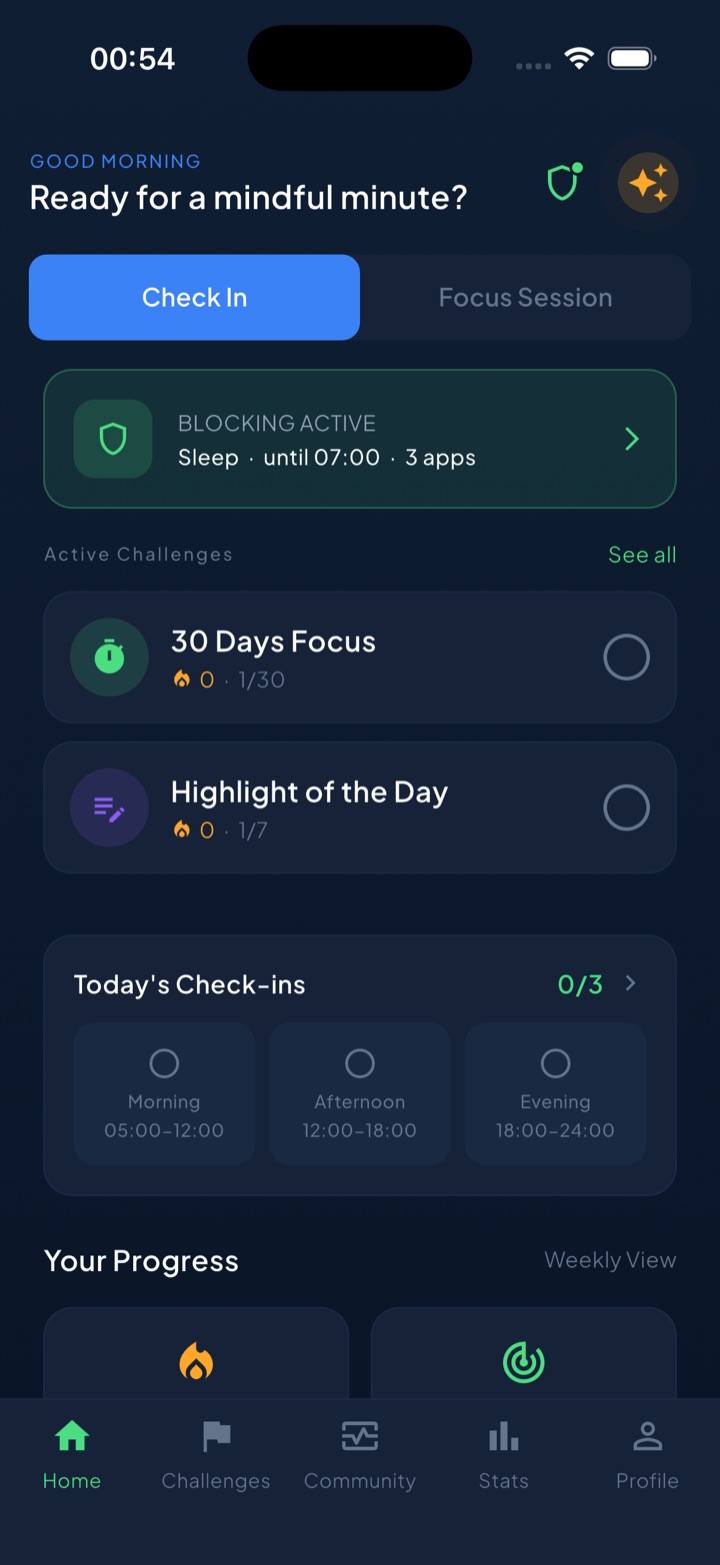
Unscrol is an iPhone and Apple Watch app for the person who wants the boundary to hold, which in a family usually means an older teenager willing to opt in, and the parent’s own phone. You set a daily total (45 minutes by default) and a per-session maximum (5 minutes by default), enforced through Apple’s Screen Time and FamilyControls frameworks rather than a cosmetic overlay. Spend a session-sized chunk of the budget and the chosen apps lock for 15 minutes; spend the whole daily budget and they lock until tomorrow. For mirroring the school, Shield is scheduled blocking by time of day: set it to the school hours and the homework block, and switching it off mid-block is deliberately slow, a breathing exercise and a wait rather than a one-tap escape. A streak counts every day under budget, and home-screen and lock-screen widgets show what is left without opening anything.
Two caveats, plainly. The usage numbers are estimates, because iOS reports crossed thresholds across an interval rather than exact minutes, so treat the budget as approximately right. And iOS hands the app opaque tokens, never app identities: Unscrol cannot see which apps were picked, their names or their icons, the system draws the picker and the app only draws the frame around it, and block lists and usage stay on-device. Free to download, with an optional premium tier adding Streak Saver for a missed day and five concurrent challenge slots instead of one.
Frequently asked questions
Do school phone bans actually improve grades?
Modestly, and unevenly. The most cited study of English secondary schools found test scores rose by about six percent of a standard deviation after a ban, which is roughly the equivalent of adding an extra hour of schooling a week. The important detail is that almost all of that gain landed on the lowest-achieving students, with the effect for high achievers close to zero. So a ban is best understood as a policy that helps the students who were losing the most to distraction, rather than one that lifts a whole cohort.
Is it enough for phones to be switched off in students' bags?
It is better than nothing and worse than most schools assume. Research on the mere presence of a smartphone found that people performed worse on working memory and reasoning tasks when their phone was face-down on the desk than when it was in another room, with the bag falling somewhere in between, and silencing the phone did not close the gap. Participants insisted the phone was making no difference to them, which is exactly the problem. This is why bans that put phones in a locker or a locked pouch at the door tend to produce clearer results than bans that rely on the phone staying quiet in a rucksack.
What about emergencies? I want to be able to reach my child.
Every school that has gone phone-free has had to answer this, and the standard answer is that the school office remains reachable by phone during the day, exactly as it was for the decades before students carried devices. Emergency services and several school-safety bodies have also pointed out that in a genuine crisis, hundreds of students on their phones can make a building harder to evacuate and harder to communicate with. The anxiety is completely understandable, but a direct line to your child is not the same thing as a safety plan, and schools generally have the second one.
Will a school ban fix my child's screen time?
No, and it is worth being clear-eyed about the arithmetic. Teenagers spend somewhere in the region of four to five hours a day on social apps, while a school day can only remove perhaps an hour or an hour and a half of that. A 2025 study across English secondary schools found that students at restrictive schools used their phones only slightly less overall than students at permissive ones, and showed no measurable difference in wellbeing, sleep or attainment. The ban moves the school day. The rest of the day is still yours to design.