Checking the news over and over is not being informed. It is monitoring, and monitoring is anxiety wearing the costume of duty. Reading one good summary once a day makes you an informed person. Refreshing headlines twelve times between breakfast and bed makes you an agitated person who knows roughly the same set of facts. The impulse underneath the habit is a decent one: you want to know what is happening in the world you live in, pay taxes in and vote in. The habit itself has stopped paying that impulse back.

Is news fatigue real, or am I just not tough enough?
It is real, it is measured, and it is now enormous.
The Reuters Institute has run an annual global survey of news consumption for over a decade across dozens of countries. Its most striking recurring finding is that roughly four in ten people now say they sometimes or often actively avoid the news, and that share has climbed steadily rather than spiking once and settling.
The reasons are the interesting part. Nobody says the news is boring or unimportant. They say it wears them down, that it makes them feel powerless, that there is too much of it and that it repeats. People who describe themselves as caring deeply about current events are heavily represented among the avoiders.
That combination, caring and avoiding at once, is the signature of fatigue rather than indifference. You do not walk away from something you never wanted. You walk away from something that has been taking more than it gives, for a long time.
Why do headlines make me anxious when nothing has changed?
Because a headline is not a summary of the day. It is an entry in a competitive market for your attention, and in that market arousal wins.
The bias is measurable. In an analysis of hundreds of thousands of real headline experiments, each additional negative word in a headline raised the click-through rate, while positive words pushed it down. Nobody involved has to be cynical for this to happen. The loop simply selects: whichever phrasing keeps people reading survives, and that is the phrasing that lifts your heart rate slightly.
Rolling coverage then does the second half of the damage. A single developing story generates forty variations before any of the underlying facts change: the initial report, the reaction, the reaction to the reaction, the analysis, the correction. Each pass costs your body close to the full price of the first, because your nervous system responds to the framing rather than to the novelty. Your knowledge barely moves. Your baseline arousal does.
Researchers studying reactions to a widely covered disaster found that hours of repeated media exposure predicted more acute stress symptoms than physical proximity to the event did for some people. Watching, repeatedly, from a safe distance, is not a neutral act. That is why doomscrolling is treated as its own behaviour rather than as reading a lot, and why the link between feeds and anxiety shows up so consistently.
Information or monitoring: which one am I actually doing?
Here is the distinction that fixes almost everything.
| Information | Monitoring | |
|---|---|---|
| Question it answers | What happened, and what does it mean? | Has anything changed since I last looked? |
| How often | Once or twice a day | Every spare moment |
| Format | Digest, bulletin, long read, newspaper | Rolling feed, push alert, live blog |
| What it adds | Understanding | Arousal |
| How it ends | You finish it and close it | It does not end |
| What it feels like | Being caught up | Being on call |
Only one of those columns has an ending. Information terminates: you read the thing, you understand more than you did, you put it down. Monitoring cannot terminate, because its question can be asked again in ninety seconds and will always have a technically new answer.
You are not the situation room. Nobody is waiting on your read of the wires, no decision anywhere is queued behind your next refresh. The feeling of being on call is real and physical; the job it corresponds to does not exist.
Does checking more often make me better informed?
Test it honestly. Think of a story you have followed closely for a fortnight, then write down in your own words what actually changed in it this week and what it means for anyone involved.
Most people find they can produce a mood but not a paragraph: a strong sense of how bad things are, and very little structure underneath it. That is what forty checks buys. Frequency delivers recency, not comprehension, and comprehension was what you thought you were paying for. Nine out of ten checks add no facts you did not have from the first. What they add is another dose of the framing. And once headline checking becomes your default gap-filler, it colonises every pause in the day, which is the popcorn brain pattern in its purest form.
How do I stay informed without the anxiety?
Four rules. None of them require you to care less.
Appointment news. Once or twice a day, at set times, for a set length. Never in the first hour after waking and never in the last hour before sleep, because those two windows set the tone of your day and the quality of your night, and neither is improved by wire copy. Midday and early evening suit most people.
Format downgrade. Move from the highest-arousal format available to the lowest one that still informs you: a daily digest email, an evening bulletin, a weekend newspaper. All of those have an end. Rolling feeds and live blogs are designed not to. Then turn news notifications off completely, including the ones you are sure are important. A push alert is a stranger deciding that your nervous system should be interrupted right now. If that feels drastic, notification overload covers doing the same across the whole phone.
The agency filter. For each story, ask one question: is there an action I will actually take? Donate, vote, volunteer, prepare, call someone, change a plan. If yes, do it now, within five minutes, and then release the story. If no, you are allowed to be sad about it and move on. Carrying a story you cannot act on does not help a single person inside it. It only converts their situation into your insomnia.
One source deeper, not five wider. Five outlets covering the same event give you the event five times, not five times the understanding. One long, well-made piece a week will teach you more than a month of headlines.
“I used to check the headlines before my feet hit the floor, then all through the day between lessons, then again in bed. I thought that was what being a responsible adult looked like. Now I read one digest at lunch and a proper newspaper on Saturday, and here is the part that annoyed me: I can hold a better conversation about the world than I could when I was checking forty times a day. I was not informed. I was just alarmed on a schedule.” — Daniel, secondary school teacher, 41
When is monitoring actually the right call?
Sometimes it genuinely is, and pretending otherwise makes the whole protocol brittle.
If there is an acute event where you actually are, such as severe weather bearing down on your area, an emergency on your street, or a family member in the middle of something, then live updates are exactly the right tool. Monitoring is appropriate whenever the incoming information changes what you will do in the next few hours.
The trick is to declare it rather than drift into it. Name the trigger and name the exit before you start: I am in crisis mode because of this specific thing, I follow the local emergency source only, and I come out when it resolves. Without a stated exit, crisis mode quietly becomes the permanent setting long after the crisis has passed, and a habit formed during three real days then runs for six months on nothing.
Am I not just looking away from things that matter?
This is the belief that actually keeps people scrolling, so it deserves a straight answer.
An informed citizen is someone who understands what is happening and acts where they can. It is not someone who watches the most hours. There is no mechanism by which your twelfth check of the day helps a single person in a single story, because nobody has ever been helped by being witnessed harder. Meanwhile the version of you that is depleted and quietly convinced that nothing can change is measurably less likely to do the local, boring, effective things: showing up, giving, organising, voting.
This is not withdrawal, it is rationing. Your concern goes to the few things you can actually move, instead of spreading itself in a thin panic across everything you cannot. JOMO is the same principle applied to social life: choosing what to miss is what makes the rest of it mean anything.
How does Unscrol help?
The honest starting point is that a lot of this is free. Apple’s Screen Time gives you Downtime for scheduled windows and daily App Limits per app or category, and you can turn off every news notification in Settings without installing anything. That last change alone does more than most apps, and if a daily budget plus switched-off alerts is enough to hold your appointment times, you should not buy anything.
Where the built-in tools run out is enforcement at the two moments that matter most. Appointment news lives or dies on the first hour of the day and the last hour of the night, and Apple’s limits ship with a one-tap dismissal at exactly the moment you are least inclined to respect them. There is also no native cap on a single sitting, so a quick check has no floor.
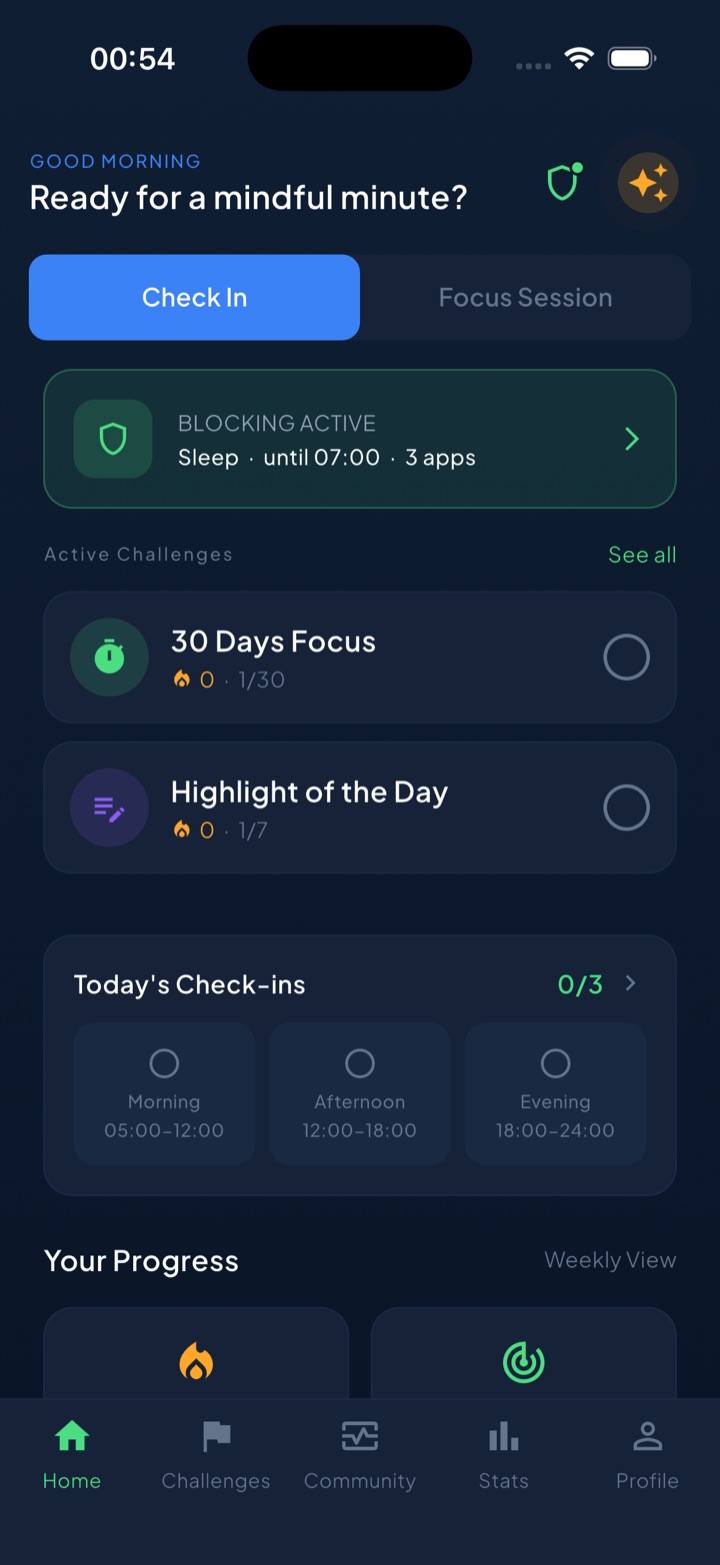
Unscrol is an iPhone and Apple Watch app built around those two gaps. You set a daily total (45 minutes by default) and a per-session maximum (5 minutes by default), enforced through Apple’s Screen Time and FamilyControls frameworks rather than by a cosmetic overlay. Spend a session-sized chunk of the budget and your chosen apps lock for 15 minutes, which is what turns a quick check back into a check; spend the whole daily budget and they lock until tomorrow. Shield is scheduled blocking by time of day, so a 7am and an 11pm window is a setting rather than a promise, and switching Shield off mid-block is deliberately slow: a breathing exercise and a wait, not a one-tap dismissal. A streak counts every day you stay under budget, and home-screen and lock-screen widgets show what is left without you opening anything.
Two caveats, plainly. The usage numbers are estimates, because iOS reports crossed thresholds across an interval rather than exact minutes, so treat the budget as approximately right rather than precise to the second. And iOS hands the app opaque tokens rather than app identities: Unscrol cannot see which apps you picked, their names or your per-app usage. The system draws the picker; the app only draws the frame around it, and block lists and usage data are processed on-device and never reach Unscrol’s servers. Free to download, with an optional premium tier adding Streak Saver for a missed day and five concurrent challenge slots instead of one.
Frequently asked questions
What is news fatigue?
News fatigue is the exhaustion that builds up from consuming a high volume of distressing news without any corresponding sense of understanding or agency. It shows up as a heavy, drained feeling when you open a news app, a sense that the news repeats itself, and a growing conviction that nothing you learn can be acted on. It is measured rather than anecdotal: the Reuters Institute's annual global survey has tracked a steady rise in people who say they sometimes or often actively avoid the news, with roughly four in ten now reporting it. Crucially, the reasons people give are exhaustion and powerlessness rather than lack of interest, which is why fatigue is a better description than apathy.
How many times a day should I check the news?
Once or twice, at set times, is enough for almost everyone who is not a journalist or an emergency responder. The reason is that frequency delivers recency rather than understanding, and after the first read of the day the additional checks are mostly re-exposure to the same framing with very few new facts attached. A good rule is to avoid the first hour after waking and the last hour before sleep, since those two windows set the tone of your day and the quality of your night. If something genuinely enormous happens, you will hear about it without refreshing anything.
Is it irresponsible to stop reading the news constantly?
No, because constant reading is not what makes someone a good citizen. An informed person is someone who understands what is happening and acts where they can, not someone who watches the most hours of coverage. There is no mechanism by which your ninth check of the day helps anyone in any story, and the depleted, cynical version of you that heavy consumption produces is less likely to do the local and effective things like voting, giving, volunteering or organising. Reading one substantial summary daily and acting on what you can is a higher standard of citizenship than refreshing headlines all day.
Should I turn off news notifications?
Yes, all of them, including the ones that feel important. A push alert is a decision made by a stranger that your nervous system should be interrupted at this exact moment, and breaking news alerts are optimised for urgency rather than significance. Turning them off does not mean you will miss anything that matters, because anything that genuinely matters will still be there at your next scheduled read, and the truly rare events that require immediate action reach you through people rather than apps. This single change is usually the highest-impact step in the entire protocol.