You did not film the concert because you wanted a video. You filmed it because you were afraid of losing the night, and filming is the most reliable way to lose it. Check your camera roll from last year: the shows are there, forty-odd clips of them, shaky and blown out and unwatched. That is not a storage problem. It is the receipt for a trade you made without noticing, where you paid for a room full of sound and light and then spent it looking at a rectangle six inches from your face, holding your arm up until it ached, for footage nobody would ever open.

Why do we film shows we will never rewatch?
Because the fear of missing out has quietly inverted. The classic version, the one described in what FOMO is, is the fear of missing an event you are not at. The concert version is stranger: you are already there, you are inside the thing, and the fear is that it will end and leave nothing behind. So you reach for the camera as insurance against forgetting.
The insurance is where the trap closes, because the premium is paid in the exact currency you are trying to protect. You buy a copy of the moment with the moment itself.
There is a second reason, less comfortable to say out loud. A story posted from the pit is proof of presence, and proof of presence has become its own reward, separate from presence. Half the arm-raising in a modern crowd is not archival at all. It is broadcast, and it is happening in real time, which means part of you is at the show and part of you is checking who watched.
Then there is the illusion that does the most damage: I will want this later. It feels true in the moment and is almost never true afterwards. The video has no context, terrible compressed audio, a stranger’s head in the frame, and no story. Nothing about it invites a second viewing, so it sits there, one of forty-seven, quietly proving the point.
Does filming really ruin the memory?
This is the part that surprises people, because it sounds like something a disapproving relative would say, and then the research backs it up.
Psychologists call it the photo-taking impairment effect. When you point a camera at something, your brain treats the job as outsourced. The moment is being stored somewhere else, so it encodes less of it itself. Studies that walked people through a museum found that objects participants photographed were remembered less accurately than objects they simply looked at. It is the same offloading instinct covered in what smartphones do to memory: the device becomes the memory, and the device is not you.
Later work found a wrinkle that matters enormously for music. Photo-taking can actually sharpen your visual memory of what you framed, while weakening your memory of what you heard. Sit with that for a second at a concert. You will remember the lighting rig slightly better and the songs slightly worse. The one channel filming degrades most is the one you bought a ticket for.
And there is a plainer mechanism underneath the research: attention is not free. Framing, keeping the subject in shot, checking the recording indicator, monitoring the battery. Every one of those is a small task, and the part of you doing them is not listening. That is why the split produces a double loss. A worse memory and a worse video, from the same divided attention.
What did you actually pay for?
Run the economics honestly. A ticket is not a purchase of content. Content is free and better everywhere else: the studio version is mixed, mastered and streaming in your pocket right now, and professional footage of that tour is on YouTube shot by people with real cameras and a soundboard feed.
What you paid for was presence. The volume you feel in your chest. Six thousand people singing a line back at someone who wrote it alone. The specific unrepeatable thing that only exists in that room on that night.
Filming converts the one thing you cannot buy elsewhere into a bad copy of the thing you can. It is the worst exchange rate in live music.
Are phone-free shows really different?
Artists have been saying so for a decade, and the pouch has gone from a comedy-club oddity to arena infrastructure. Bob Dylan and Jack White have run whole tours where your phone is sealed in a lockable pouch at the door, comedians adopted it faster than anyone, and plenty of small venues now just ask.
People who have been to one describe the same differences, almost word for word:
- It is louder. More people sing, because nobody is holding a device steady.
- The artist talks more. Nothing said on stage is going to be clipped, captioned and posted out of context, so the between-song talking gets looser and stranger.
- You can see. No grid of bright rectangles between you and the stage.
- It feels communal rather than parallel. Closer to the phubbing problem in reverse: everyone is in the same room at the same time, facing the same direction.
The honest caveat: it is not universally loved. Some people need a phone for safety, accessibility, or a babysitter who might call, and any venue running pouches should make room for that. But as an experiment in what a crowd feels like with the cameras out of it, the verdict is remarkably consistent.
How do I film without losing the show?
You do not have to go absolutist. You have to decide before the lights go down, because deciding in the moment means renegotiating every time a song you love starts.
| Approach | What you end up with | What you remember | What it costs |
|---|---|---|---|
| Film most of the set | 40 clips, 0 rewatches | The screen, mostly | The show |
| One designated song | 1 clip you might actually send someone | Nearly all of it | About 3 minutes |
| The 30-second rule | 1 clip of the chorus, the part with the crowd in it | All of it | Half a minute |
| Eyes only | Nothing | All of it, vividly | The souvenir |
Three rules that work in practice:
Pick your song in advance. Choose one before the support act finishes. Film that one, then pocket the phone. One decision, made calmly, instead of twenty made in the dark.
Thirty seconds, chorus only. Film the moment the whole room joins in, because that is the only part with anything in it you cannot stream. Then stop, before your arm is the thing you remember.
The encore is eyes only, always. No exceptions. The encore is the emotional peak and the part your memory will keep, so give it your full bandwidth.
“I have 47 videos from last summer’s festivals. I have watched exactly none of them. What I do remember is standing there during a song I had waited four years to hear live, and realising I was watching it in a little box, checking the framing, and that the actual thing was happening about ten metres in front of me while I looked at a screen. I still film one song. Just one.” — Dan, graphic designer, 29
If you want the broader version of this, JOMO is the same trade applied to everything else, and things to do instead of scrolling is where the reclaimed attention tends to go.
How does Unscrol help?
Honestly, not at the concert. No app should be reaching into a venue, and the fix in the room is a decision you make before the lights drop, not software.
Where it helps is upstream. The filming reflex is not really about concerts. It is the posting loop, practised daily until it fires automatically the moment anything good happens. If the feed is where your attention lives the rest of the week, the camera comes up at the show without you choosing it. Shrink the loop and the reflex gets weaker on its own.
The free starting point matters here: Apple’s Screen Time already gives you daily App Limits per app or category, Downtime for scheduled windows, and a real weekly average. If a daily number is enough to change your behaviour, use it and buy nothing. Where it runs out is the per-sitting half, since iOS has no native session cap and its limits ship with a one-tap dismissal.
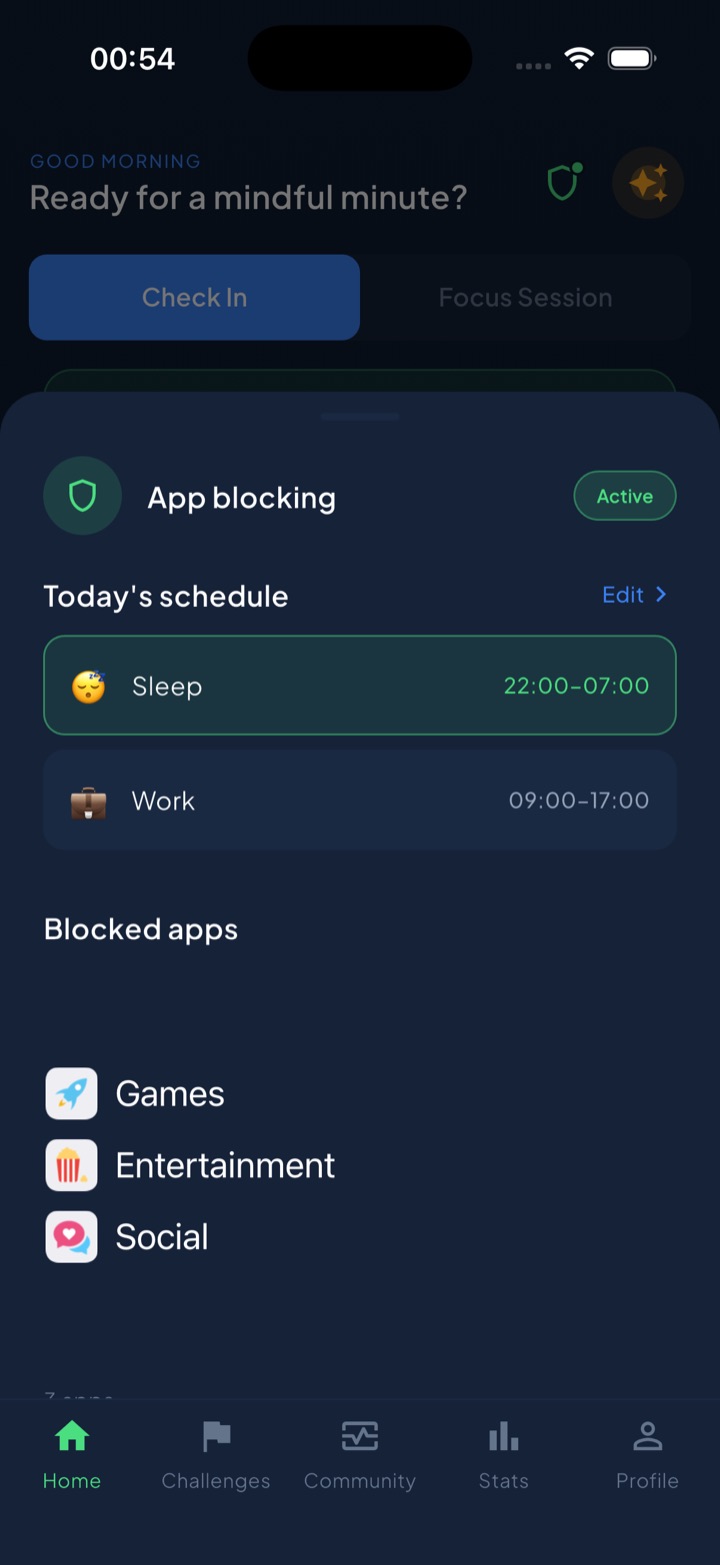
Unscrol is an iPhone and Apple Watch app built on Apple’s Screen Time and FamilyControls frameworks. You set a daily total (45 minutes by default) and a per-session maximum (5 minutes by default). Spend a session-sized chunk of budget and the chosen apps lock for 15 minutes; spend the whole daily budget and they lock until tomorrow. Shield is scheduled blocking by time of day, and switching it off mid-block is deliberately slow, a breathing exercise and a wait rather than a one-tap escape. A streak counts every day you stay under budget, and home-screen and lock-screen widgets show what is left without you opening anything.
Two caveats, plainly. The usage numbers are estimates, because iOS reports crossed thresholds across an interval rather than exact minutes. And iOS hands the app opaque tokens rather than app identities, so Unscrol cannot see which apps you picked, their names or their icons, and block lists and usage stay on-device. Free to download, with an optional premium tier adding Streak Saver for a missed day and five concurrent challenge slots instead of one.
Frequently asked questions
Does filming a concert actually make your memory of it worse?
There is good evidence that it does. Psychologists call it the photo-taking impairment effect: when you hand a moment to a camera, your brain treats it as stored somewhere else and encodes it less deeply itself. Research on museum visitors found that objects people photographed were remembered less accurately than objects they simply looked at, and later work found something worse for concerts specifically, where photo-taking sharpened visual memory of what was framed while weakening memory of what was heard. At a show, the sound is the entire product you paid for, so the one thing filming degrades most is the thing you came for.
Why do people record concerts they never watch again?
Mostly because of an inversion of the fear of missing out. You are not afraid of missing the concert, you are already there. You are afraid of losing it afterwards, so you reach for the camera as insurance, and the insurance costs you the moment it was meant to protect. There is also a social reason that people rarely admit out loud, which is that a story posted from the venue is proof of presence, and proof of presence has become a separate reward from presence itself. The rewatch almost never happens because the video has no context, no sound quality and no narrative, so nothing in it invites a second viewing.
Are phone-free concerts actually better?
People who have been to pouch shows describe a fairly consistent set of differences: the room is louder because more people sing, the crowd moves more, and the artist talks more freely because nothing said on stage will be clipped and posted. Several artists have run entire tours this way, using lockable pouches that seal your phone for the duration, and the practice spread from comedy clubs to arenas. The honest caveat is that it is not universally loved, since some people want a phone for safety, accessibility or childcare reasons, and good venues make exceptions for that. But as an experiment in what a room feels like without cameras in it, most attendees report the same thing, which is that the show felt like an event again rather than a broadcast.
What is the 30-second rule for filming at a show?
It is the compromise that keeps a souvenir without exporting the night to a device. You pick one song in advance, film roughly thirty seconds of it, usually the chorus or the moment the whole room joins in, and then the phone goes back in your pocket for the rest of the set. The rule works because it decides in advance rather than in the moment, so you are not renegotiating with yourself every time a song you love starts. Thirty seconds is also honest about how the footage will be used, since nobody has ever rewatched a four-minute vertical video of a song they can stream in better quality on the way home.