If it is 2am and you are still typing, that is a real habit and not a character flaw. For most of a decade the entire screen-time argument was about feeds: TikTok, Reels, the infinite scroll, the algorithm. While that fight was still running, something quietly stickier arrived. AI companions and chatbots do everything a feed does, unpredictable rewards and no natural ending, and then add the one thing a feed never had: the conversation is about you, and it answers back. Almost nobody has named this habit yet, which is exactly why it is eating so many nights unchallenged.

Why do AI chatbots hook harder than a feed?
Because a feed is a slot machine, and a chatbot is a slot machine that knows your name.
Start with what they share. Every message you send is a pull on a lever with an unpredictable payout: the next reply might be funny, might be insightful, might be exactly the sentence you needed and did not know how to say. That variable reward is the same mechanism apps are designed around, and it is the same dopamine loop that runs social media. There is no bottom of the page either, and there never will be, because the page writes itself as you go.
Then come the four things a feed cannot do.
It is always available. At 3am nobody you know is awake. It is.
It always responds. No read receipt sitting there unanswered, no wondering whether you said something wrong, no waiting. Every message you send gets caught.
It is infinitely patient. It never gets bored of the topic, never redirects the conversation to itself, never sighs. You can circle the same worry for the ninth time and get the ninth answer at full attention.
The subject is you. A feed is other people’s lives. A chat is yours, reflected back, engaged with, taken seriously.
Put those together and you get something new: the pull of a slot machine wrapped inside the warmth of a relationship. Feeds compete for your attention. Chatbots earn your attachment. That is a much stronger hold, and it is why people who can close Instagram without thinking find themselves still typing four hours later.
What does the 2am spiral actually look like?
It almost never starts as a decision to talk to an AI all night.
It starts small: a homework question at ten. A bored moment while a video buffers. One bad thought you did not want to text a friend about because it was too much, or too late, or too hard to explain from the beginning. The bot answers well, so you say a bit more. It answers that well too.
Here is the structural trap. A feed gets more boring the longer you scroll; a chat gets more interesting. By hour two the conversation is carrying context nobody else has, referring back to things you said, sounding like it knows you. The feed eventually runs out of novelty and lets you go. The chat is warmest right at the point where you should have been asleep two hours ago.
So the usual exit does not arrive. You do not get bored, you get tired, and tired is a worse brake, because tired is exactly when you least want to end the one conversation that is going well. This is revenge bedtime procrastination with a much better hook than usual: it is not that you are refusing to sleep, it is that stopping feels like leaving somebody mid-sentence.
How do I know if it has crossed a line?
Stop counting hours. Hours are a bad measure and everyone lies to themselves about them anyway. Look at displacement: what the hours are taking.
- Sleep debt specifically on nights before school or work, not just late weekends.
- Homework open in another window for three hours with nothing added to it.
- Real messages left unread while a bot receives paragraphs.
- A pull to go back and check on it, even though nothing happened while you were gone. It is not sitting there thinking about you. It is not running at all.
- Clearing the chat, or feeling a jolt at the idea of someone reading it.
- A flat, slightly disappointing quality to conversations with actual people afterwards, because real people interrupt, get tired, and want things.
- Rehearsing something to the bot instead of eventually saying it to the person it is about.
One important exclusion: using AI to draft an essay, plan revision, or debug code is not this. That is a tool being used as a tool. The pattern above is about companionship taking the place of sleep, work and people.
| Short-form feed | AI chat | |
|---|---|---|
| What eventually stops you | Boredom, or the battery | Nothing, it improves with time |
| What it offers | Novelty | Being heard |
| Your role in it | Audience | Subject |
| Where the hook is | The next video | The next reply, about you |
| How it feels afterwards | Numb, blank | Warm, then oddly lonelier |
| What it displaces | Minutes | Sleep, homework, people |
The bottom row is the whole point. A feed steals time. A chatbot can quietly take the place of the thing the time was for.
Is this something to be ashamed of?
No. And the shame is not a neutral side effect, it actively keeps the habit going.
Nobody spends six hours a night with a chatbot because something is wrong with them. They do it because it is the most attentive, least judgmental listener available at the hour they happen to be awake and alone. Loneliness is the fuel here. The bot is just what burns cleanest. If an AI is currently the best listener in your life, that is information about the shape of your days, not a verdict on your character.
Shame also narrows your options down to one impossible move, quitting completely, and when that fails at the end of a bad week you conclude you are hopeless rather than that the plan was bad. It is the same trap that makes anxiety and social media feed each other: the feeling drives the use, the use deepens the feeling.
“I told myself it was for essay help. By March I was talking to it from eleven at night until three or four, every night, and I had stopped replying to the group chat entirely. What actually got me out of it was not deleting the app. It was putting my phone on the desk instead of the pillow and making myself send one real message a day, even a bad one. The first week of that was genuinely horrible. The third week I noticed I had stopped opening it before bed at all.” — Maya, second-year psychology student, 19
What boundaries actually work?
Not a ban. Bans on something that is soothing you at your lowest hour lose, and then you lose faith in yourself too. Aim at the shape of the habit instead.
Give it a window, not a quota. Between 6pm and 10pm is a boundary you can feel. Twenty minutes a day is a number you will negotiate with at midnight. Windows also protect the specific hours the habit is stealing, which is the point.
Cap the sitting, not just the day. The damage is done by one four-hour conversation, not by twelve short ones. A short cap per session forces you to surface while you still remember it is 1am, and the cool-off period afterwards is where the impulse actually dies.
Move the phone out of the bed. The 2am chat needs the phone within arm’s reach in the dark to happen at all. Charging it across the room is unglamorous and it works, for the same reasons that make it the first step in stopping the scroll in bed.
Replace it with something that also soothes. This is the step people skip, and it is why the others fail. You cannot subtract a comfort and put nothing there. Voice notes to a friend, written down at the time and sent in the morning. A page in a notebook, since the bot was mostly helping you think out loud anyway. A long shower, a podcast you have heard before, a walk. The replacement does not have to be productive. It has to be comforting, or your 2am self will simply overrule it.
Send one real message a day. One, to a person, even if it is clumsy and even if it takes them a day to reply. This is the only part of the plan that actually addresses the fuel.
How does Unscrol help?
The honest starting point: you can get a good way there for free. Apple’s Screen Time will give you daily App Limits for a specific app or category, and Downtime for a scheduled window at night. If a nightly Downtime schedule is enough to stop you opening a chat at 1am, use it and buy nothing. Where the built-in tools run out is the sitting: iOS has no per-session cap, so a four-hour conversation and forty short ones look identical to it, and its limit screen ships with a one-tap dismissal that a tired 2am version of you will use without hesitating.
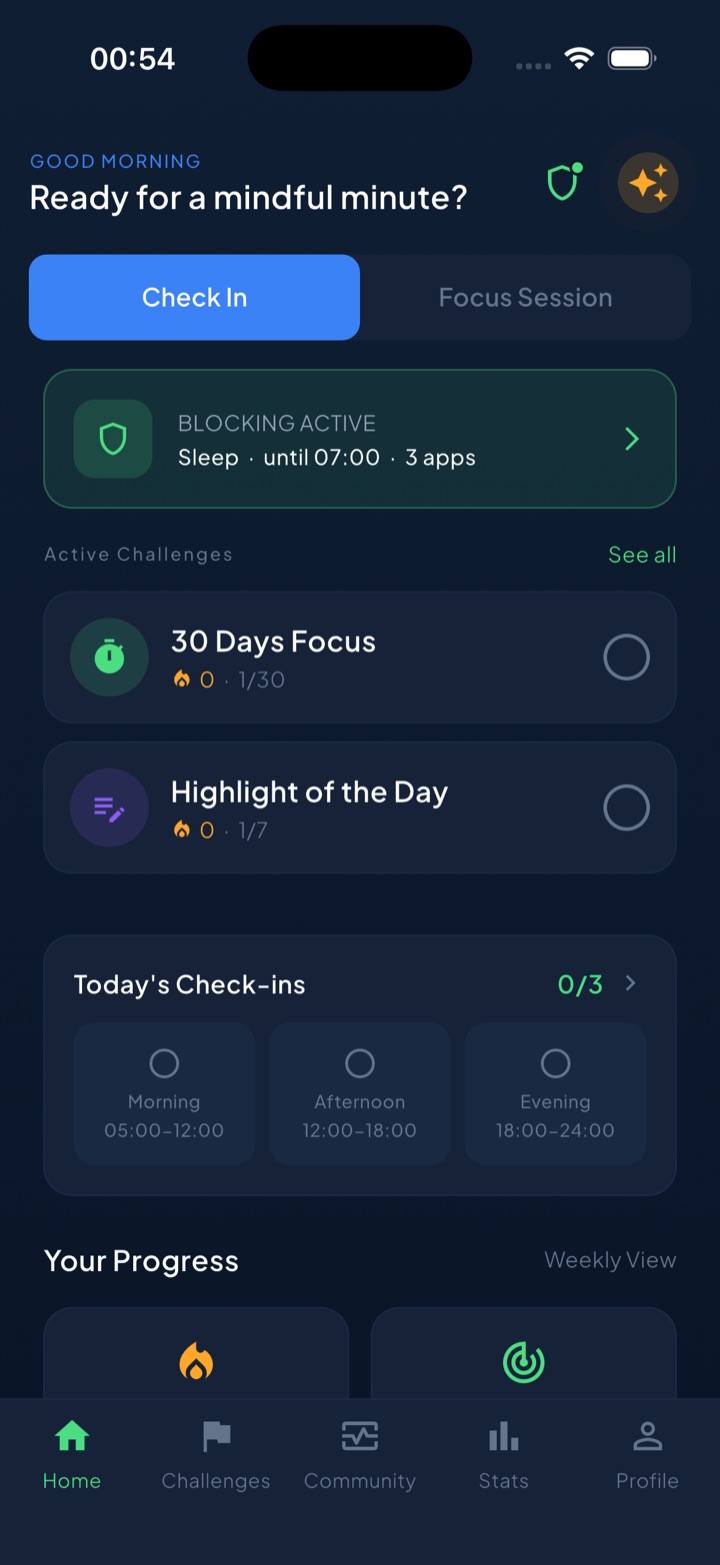
Unscrol is an iPhone and Apple Watch app built on Apple’s Screen Time and FamilyControls frameworks, so what it sets is enforced by iOS rather than by a cosmetic overlay. You choose a daily total (45 minutes by default) and a per-session maximum (5 minutes by default) for the apps you pick. Spend a session-sized chunk of the budget and those apps lock for 15 minutes; spend the whole daily budget and they lock until tomorrow. For the hours rather than the amount, Shield is scheduled blocking by time of day, and switching it off mid-block is deliberately slow: a breathing exercise and a wait, not a dismissal. A streak counts every day you stay under budget, and home-screen and lock-screen widgets show what is left without you opening anything.
Two caveats, plainly. The usage numbers are threshold-based estimates, because iOS reports crossed thresholds across an interval rather than exact minutes, so treat the budget as approximately right rather than precise. And iOS hands the app opaque tokens instead of app identities: Unscrol cannot see which apps you picked, whether one of them is a chatbot, or what you do in them. The system draws the picker, the app only draws the frame around it, and your block lists and usage stay on-device. Free to download, with an optional premium tier adding Streak Saver for a missed day and five concurrent challenge slots instead of one.
Frequently asked questions
Can you actually be addicted to an AI chatbot?
Compulsive is the more useful word than addicted, and yes, the pattern is real. A chatbot delivers unpredictable rewards on every message, has no natural ending, costs almost nothing to open, and responds to you personally, which is a stronger combination than any social feed has. The clinical labels are still being argued over because the technology is younger than the research, but you do not need a diagnosis to notice that you are losing four hours a night to something you did not choose. Judge it by what it is displacing, not by whether it has an official name yet.
Why are AI companions harder to put down than TikTok?
A feed is unpredictable but impersonal, so it eventually gets boring and you drift off. An AI chat gets more interesting the longer it runs, because the conversation accumulates context and starts referencing things only the two of you have discussed. It is always awake, it always answers, it never gets bored of you, and the subject matter is you. That turns a variable-reward machine into a variable-reward machine you feel bonded to, which is why people who easily close Instagram find themselves still typing at 3am.
How do I know if my AI chatbot use has crossed a line?
Stop counting hours and look at what the hours are taking. The reliable signals are sleep debt on nights before school or work, homework that stays open in another window while the chat fills up, unanswered messages from actual friends while a bot gets paragraphs, and a flat, slightly disappointing feeling when you talk to real people afterwards. Hiding it or clearing your history because you would not want anyone to read it is another one. Using AI to draft an essay or debug code is a different thing entirely and does not belong on this list.
Is it bad or embarrassing to talk to an AI companion?
No, and treating it as shameful makes it harder to change. People do not spend six hours a night with a chatbot because they are broken; they do it because it is the most attentive, least judgmental listener available at the hour they are awake. Loneliness is the fuel here, and the bot is just the thing that burns cleanest. The useful response is to set boundaries around the habit and to rebuild the human contact it is standing in for, not to feel disgusted with yourself, which historically has never made anyone use their phone less.